
Commercial property management is the professional oversight of income-generating real estate assets, including retail spaces, office buildings, industrial facilities, and mixed-use developments. In Thailand, the commercial property sector generated approximately ฿1.2 trillion in annual revenue as of 2025, with Koh Samui emerging as a high-growth market for retail and hospitality-commercial hybrid spaces [^1^]. This guide covers the legal frameworks, operational strategies, and financial optimization techniques specific to managing commercial properties in Thailand’s unique regulatory and market environment.
What Is Commercial Property Management?
Commercial property management encompasses 6 core functions: tenant acquisition and retention, lease administration, facility maintenance, financial reporting, regulatory compliance, and asset value optimization. Unlike residential management, commercial property management operates within the framework of the Thai Civil and Commercial Code (CCC), Foreign Business Act B.E. 2542 (1999), and specific lease structures including triple net leases, gross leases, and percentage rent agreements [^2^].
The Thailand Board of Investment (BOI) reports that foreign investors control approximately 35% of premium commercial properties in major tourist destinations, making understanding of foreign ownership restrictions and leasehold structures essential for effective management [^3^].
What Are the 4 Main Types of Commercial Properties in Thailand?
Thailand’s commercial property market comprises 4 distinct property types, each with unique management requirements and ROI profiles:
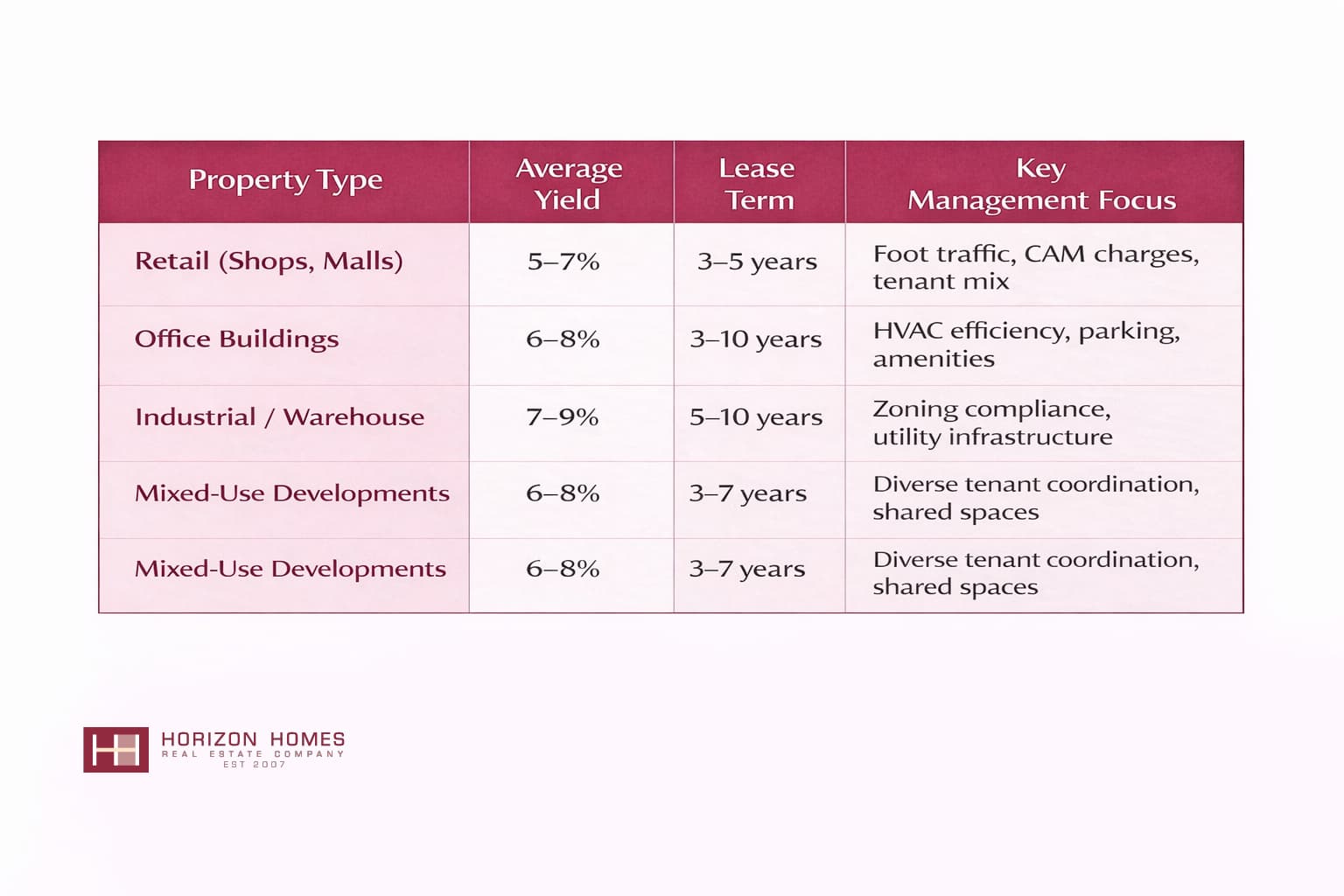
Retail properties in Koh Samui command premium rents during high season (November-April), with rates increasing 25-40% compared to low season. Office spaces in Bangkok’s CBD average ฿750-1,200 per square meter monthly, while provincial markets like Samui range ฿400-800 per square meter [^4^].
What 3 Lease Structures Dominate Thai Commercial Real Estate?
Thai commercial property management operates under 3 primary lease structures, each transferring different cost responsibilities between landlord and tenant:
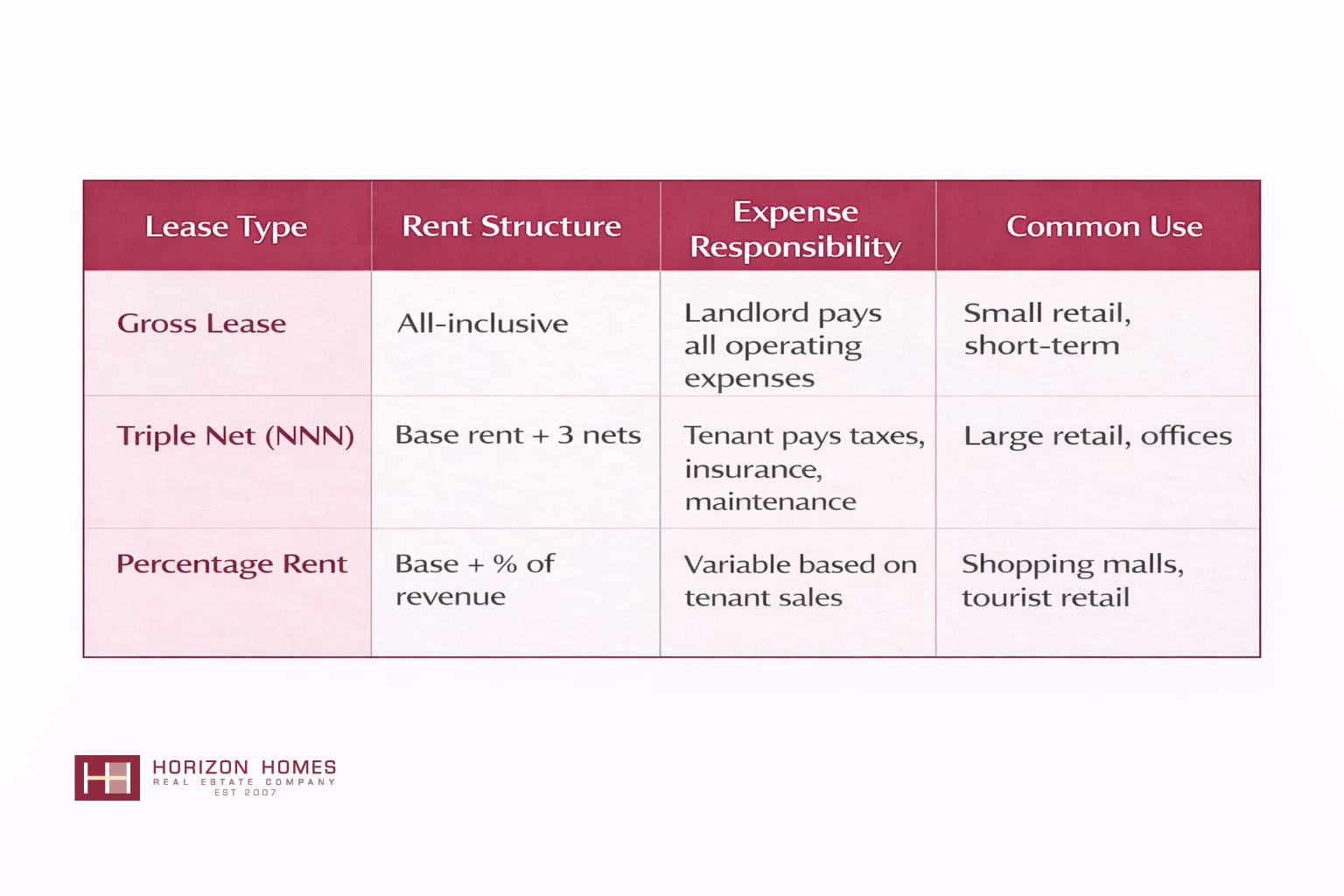
The triple net lease structure dominates premium commercial properties in Thailand, with tenants responsible for Common Area Maintenance (CAM) charges averaging ฿150-350 per square meter monthly. Foreign tenants under BOI promotion may negotiate preferential lease terms including tax incentives and extended lease periods up to 50 years under the Industrial Estate Authority of Thailand regulations [^5^].
What 6 Legal Requirements Govern Commercial Property Management in Thailand?
Commercial property managers in Thailand must navigate 6 regulatory frameworks to ensure compliant operations:
- Foreign Business Act Compliance: Foreigners cannot own land freehold but may lease commercial space for up to 30 years with renewal options
- Land Department Registration: All commercial leases exceeding 3 years require registration at the local Land Office
- Building Control Act: Properties must maintain valid building permits and occupancy certificates
- Environmental Regulations: Commercial properties must comply with Environmental Quality Standards under the Enhancement and Conservation of National Environmental Quality Act
- Tax Obligations: Withholding tax on rent (5%), specific business tax (3.3%), and corporate income tax apply to commercial rental income
- Employment Law: Property management staff fall under the Labor Protection Act B.E. 2541 (1998)
The Department of Business Development reports that 23% of commercial lease disputes in Thailand stem from unclear expense allocation between landlords and tenants, emphasizing the importance of precise lease documentation [^6^].
What 5 Strategies Maximize Commercial Property ROI?
Professional property managers implement 5 revenue optimization strategies to maximize returns:
Market-Based Rent Analysis: Conduct quarterly rent surveys comparing similar properties within 2 kilometers. Properties priced 5% below market average lose ฿50,000-200,000 annually in potential revenue for a 500 sqm space.
Tenant Mix Optimization: Strategic tenant curation increases foot traffic and cross-shopping. Shopping centers with complementary tenant mixes (food, retail, services) report 15-20% higher revenue per square meter than random tenant allocations.
Value-Add Services: Additional revenue streams include parking fees (฿20-50/hour in prime areas), digital signage rentals, storage space leasing, and premium building services.
Expense Recovery Audit: Ensure full collection of CAM charges, utility allocations, and property tax pass-throughs. Under-recovery of expenses reduces NOI by 8-12% annually.
Energy Management: Smart building systems reduce utility costs by 10-30%. LED lighting retrofits achieve payback within 18-24 months in Thailand’s commercial sector [^7^].
What 4 Maintenance Categories Protect Asset Value?
Preventive maintenance follows 4 priority tiers based on system criticality:
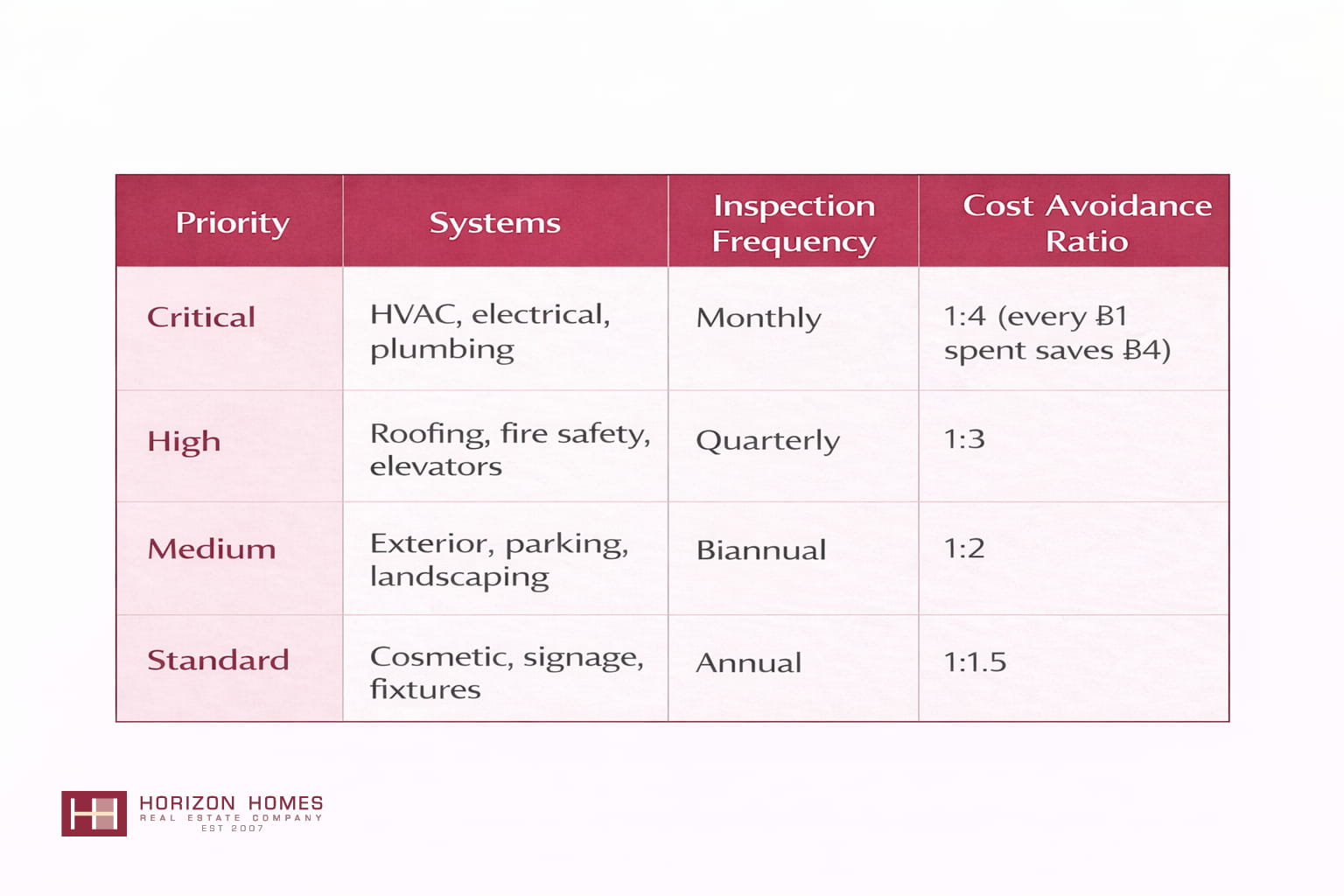
The Engineering Institute of Thailand recommends allocating 2-4% of property value annually to capital reserves for major system replacements. Air conditioning systems in tropical climates require replacement every 8-12 years, representing the largest capital expenditure for Thai commercial properties [^8^].
What 7 KPIs Measure Commercial Property Performance?
Effective management tracks 7 essential performance indicators:
Financial Metrics:
- Net Operating Income (NOI): Revenue minus operating expenses (target growth: 3-5% annually)
- Operating Expense Ratio: Operating expenses divided by effective gross income (target: 35-45%)
- Rent Collection Rate: Percentage collected on time (target: 98%+)
- Economic Occupancy: Actual rent collected versus potential rent (target: 95%+)
Operational Metrics:
- Physical Occupancy Rate: Percentage of leasable space occupied (target: 92%+)
- Tenant Retention Rate: Percentage renewing leases (target: 75%+)
- Average Days to Lease: Time between vacancy and occupancy (target: <60 days)
Properties achieving all 7 targets consistently outperform market averages by 15-25% in total returns [^9^].
What Technology Stack Powers Modern Property Management?
Contemporary commercial property management requires 5 technology categories:
- Property Management Software: Buildium, AppFolio, or Yardi for lease tracking and accounting
- Maintenance Management: Work order systems with mobile apps for real-time tracking
- Tenant Portals: Online rent payment and service request platforms
- Energy Management: IoT sensors and smart building controls
- Document Management: Cloud-based storage with audit trails for lease agreements and compliance records
The Thailand PropTech Association reports that 67% of commercial property managers now use dedicated software platforms, up from 34% in 2020. Properties utilizing integrated technology stacks reduce administrative costs by 20-30% while improving tenant satisfaction scores [^10^].
What 6 Mistakes Destroy Commercial Property Value?
Avoid these 6 critical management errors that reduce property values by 10-25%:
- Neglecting Preventive Maintenance: Emergency repairs cost 3-4 times more than planned maintenance and damage tenant relationships
- Inadequate Tenant Screening: Verify financial statements, business history, and references before lease execution
- Reactive Management: Waiting for problems creates chaos; proactive inspection schedules catch issues early
- Poor Documentation: Verbal agreements lead to disputes; document everything in writing
- Ignoring Market Trends: Properties failing to adapt to hybrid work, sustainability requirements, and technology needs become obsolete
- Underinsurance: Review coverage annually; underinsured properties face catastrophic exposure
Frequently Asked Questions
What is the average commercial property management fee in Thailand?
Management fees range from 3-6% of gross rental income for full-service management. Additional charges include lease-up fees (25-50% of first month’s rent) and project management fees for capital improvements.
How long can foreigners lease commercial property in Thailand?
Foreigners may lease commercial space for initial terms up to 30 years with renewal options totaling 90 years under the Civil and Commercial Code. BOI-promoted businesses may secure 50-year leases for industrial properties.
What taxes apply to commercial rental income in Thailand?
Commercial rental income incurs withholding tax (5%), specific business tax (3.3%), and corporate income tax (20%) for companies. Individual landlords pay personal income tax at progressive rates up to 35%.
How often should commercial properties be inspected?
Conduct monthly inspections for critical systems (HVAC, fire safety), quarterly inspections for common areas and building systems, and annual comprehensive inspections of all tenant spaces.
What is the typical lease term for commercial properties in Thailand?
Retail leases average 3-5 years, office leases 3-10 years, and industrial leases 5-10 years. Longer terms provide income stability but reduce flexibility to adjust to market conditions.
How do I calculate commercial property management fees?
Multiply effective gross income by the management fee percentage. A property generating ฿2,400,000 annually with 5% management fees incurs ฿120,000 in annual management costs. Verify inclusions—some agreements exclude leasing commissions and maintenance coordination.
What CAM charges are typical in Thai commercial properties?
Common Area Maintenance charges range from ฿150-350 per square meter monthly in Bangkok and major tourist areas like Koh Samui. CAM covers security, cleaning, landscaping, and common area utilities.
How can I improve tenant retention in commercial properties?
Maintain open communication channels, respond to maintenance requests within 24 hours, offer lease renewal incentives, modernize common areas, and build personal relationships with tenant decision-makers. Start renewal conversations 6-12 months before lease expiration.
What insurance coverage do commercial properties need in Thailand?
Essential coverage includes property insurance (building value), public liability (minimum ฿10 million), business interruption, and workers’ compensation for staff. Premiums typically range 0.3-0.8% of insured value annually.
What is the Foreign Business Act impact on commercial property?
The Foreign Business Act B.E. 2542 restricts foreign ownership of land but permits leasehold structures and condominium ownership (up to 49% foreign quota in buildings). Foreigners may own buildings but not the land beneath them.
How do energy costs impact commercial property NOI?
Energy represents 15-25% of operating expenses for Thai commercial properties. Implementing smart building systems and LED retrofits reduces consumption by 10-30%, directly increasing NOI and property value.
What distinguishes commercial from residential property management?
Commercial management involves longer lease terms (3-10 years vs. 12 months), triple net structures, business-focused relationships, complex maintenance requirements, and greater emphasis on financial reporting and ROI metrics.
Sources
[^1^]: Thailand Real Estate Information Center (REIC) – Commercial Market Report 2025
[^2^]: Thai Civil and Commercial Code, Sections 537-574 (Lease Agreements)
[^3^]: Thailand Board of Investment (BOI) – Foreign Investment Statistics 2024
[^4^]: CBRE Thailand – Commercial Property Market Report Q4 2025
[^5^]: Industrial Estate Authority of Thailand – Lease Regulations for BOI Companies
[^6^]: Department of Business Development – Commercial Lease Dispute Analysis 2024
[^7^]: Thailand Energy Efficiency Program – Commercial Building Energy Consumption Survey
[^8^]: Engineering Institute of Thailand – Building Maintenance Standards
[^9^]: Building Owners and Managers Association (BOMA) – Performance Benchmarking Study
[^10^]: Thailand PropTech Association – Digital Transformation Report 2025