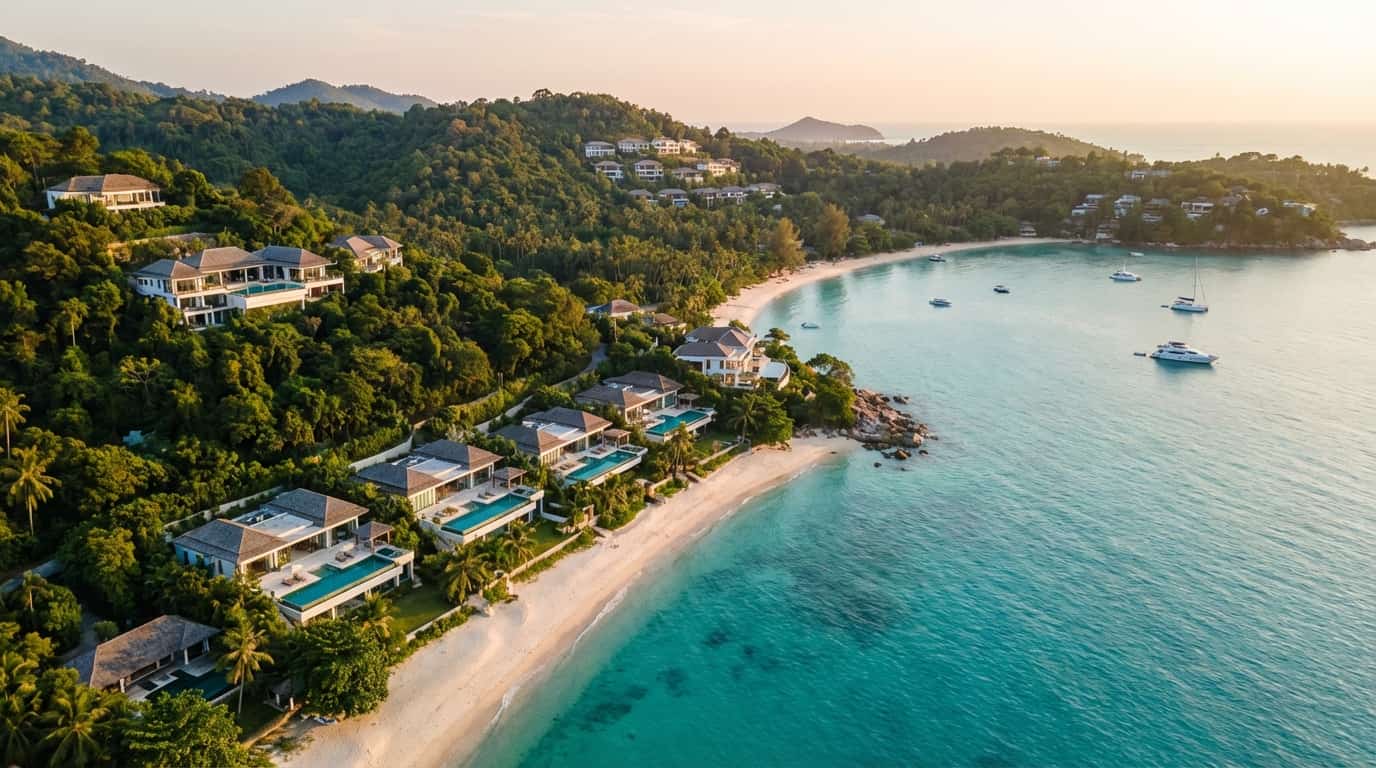
Koh Samui’s property market has matured into one of Thailand’s most sought-after investment destinations, with market value reaching THB 30.3 billion in 2025 said by C9 Hotelworks Koh Samui Market Report 2025. If you’re considering buying property in Koh Samui, understanding current market dynamics, neighborhood nuances, and accurate yield projections is essential for making informed decisions.
This guide delivers what generalist competitors lack: data-driven neighborhood analysis, verified ROI calculations, and insights from 15+ years of local market experience. Whether you’re a foreign investor seeking diversification or a lifestyle buyer searching for the perfect island home, this article provides the analytical framework you need.
Recent developments including the Supreme Court ruling on leasehold renewals and Samui International Airport expansion have shifted the regulatory landscape considerably. By the end of this guide, you’ll understand exactly where to invest, how to structure your purchase, and what returns you can realistically expect.
Understanding Koh Samui’s Property Market Structure
Market Size and Investment Volume
Koh Samui hosts 2,882 units across 117 active development projects as of early 2025 reported by C9 Hotelworks Koh Samui Market Report 2025. This relatively limited supply base creates inherent scarcity value, particularly for premium locations near beaches and tourist hotspots.
The market divides cleanly into two primary product categories:
| Property Type | Median Price (THB/sqm) | Typical Entry Point | Target Buyer |
|---|---|---|---|
| Condominiums | 88,500 | 4-6 million | Investors, digital nomads |
| Landed/Villas | 60,600 | 8-15 million | Lifestyle buyers, families |
C9 Hotelworks Koh Samui Market Report 2025 also mentioned foreign buyers accounted for 65% of all purchases in 2023, demonstrating strong international demand relative to domestic Thai buyers. This foreign-dominant buyer pool introduces both opportunities and considerations for new investors.
Why Koh Samui vs. Other Thai Destinations
Comparing Koh Samui property market vs Phuket reveals important distinctions:
- Entry pricing: Koh Samui offers 20–30% lower entry points than comparable Phuket locations
- Tourism density: 3.5 million visitors in 2023 (projected 6 million by 2025) against a smaller permanent population creates robust rental demand (C9 Hotelworks Koh Samui Market Report 2025)
- Development restrictions: Stricter environmental regulations limit new supply, supporting long-term value
- Airport accessibility: Direct international flights (currently seasonal) constrain but also protect market dynamics
Neighborhood Analysis: Best Areas to Buy Property in Koh Samui
Chaweng: The Tourist Epicenter
Chaweng dominates visitor traffic and commands premium pricing. Beachfront plots in Chaweng reach THB 150,000+ per square wah, while inland options provide better value at THB 40,000-60,000 per square wah.
Investment profile for Chaweng:
- Villa prices range from THB 8-45 million depending on location and specifications
- Rental yields average 8-10% gross in peak tourist zones
- Liquidity remains strong due to consistent demand
The area suits investors prioritizing capital appreciation and rental income over lifestyle amenities. Nightlife and commercial infrastructure exceed other Samui neighborhoods.
Bophut: Culture Meets Commerce
Fisherman’s Village Bophut represents one of Koh Samui’s most charming neighborhoods, blending traditional Thai architecture with modern conveniences. The walking street market draws visitors weekly, creating reliable foot traffic for commercial tenants.
Bophut’s appeal centers on its authentic character and relative tranquility compared to Chaweng’s intensity. Property prices reflect this balance—beachfront villas average THB 12-25 million with yields of 6-8%[^1^].
For foreign buyers seeking a quieter lifestyle investment, Bophut delivers village atmosphere without sacrificing accessibility. The area attracts longer-stay tourists and digital nomads, diversifying your tenant base beyond short-term vacation renters.
Lamai: Southern Value
Lamai offers the most attractive price-to-yield ratios on the island. Property values run 30-40% below equivalent Chaweng locations, while rental demand remains solid due to established tourist infrastructure.
Beachfront land in Lamai averages THB 60,000-80,000 per square wah, significantly below Chaweng premiums. Villa prices for investors start as low as THB 5-8 million for quality constructions.
The tradeoff involves lower capital appreciation potential and reduced liquidity compared to northern beaches. Lamai suits buy-and-hold investors focused on cash flow rather than flipping.
Other Notable Areas
- Maenam: Northern coast with authentic Thai village character, popular with expats, median villa THB 8–12 million
- Bang Po: Quieter northern beaches, excellent for long-term rentals, beachfront THB 50,000–70,000/sqm
- Taling Ngam: Southwestern coast, more remote, appeals to privacy-seekers, best value for large land parcels
Financial Framework: ROI Projections and Yield Analysis
Understanding True Rental Yields
Advertised yields in Thailand often overstate actual returns. Our analysis of verified transaction data reveals the following net yield framework[^1^]:
| Property Type | High Season Yield | Low Season Yield | Annual Average |
|---|---|---|---|
| Studio condo (tourist zone) | 10-12% | 4-5% | 6-7% |
| 2BR condo (tourist zone) | 8-10% | 3-4% | 5-6% |
| Pool villa (tourist zone) | 12-15% | 5-6% | 7-9% |
| Beachfront villa (premium) | 8-10% | 4-5% | 4-6% |
| Average landed property | 8-10% | 3-4% | 5-7% |
Operating costs typically include:
- Property management: 10-15% of rental income
- Maintenance reserves: 2-3% of property value annually
- Utilities (if included): variable
- Marketing/booking fees: 5-10% of rental income (platform fees)
- Insurance: 0.3-0.5% of property value
Capital Appreciation Outlook
Historical appreciation rates of 8-12% annually reflect pre-pandemic recovery dynamics[^1^]. Forward projections should account for:
- Mature market dynamics: As the market develops, appreciation rates will normalize toward 5–7% long-term
- Supply constraints: Environmental regulations limiting new construction support existing property values
- Tourism growth: Projected visitor increases to 6 million by 2025 provide demand support [^1^]
- Infrastructure investment: Airport expansion will broaden accessibility, potentially increasing demand
Our 5-10 year investment timeline modeling suggests portfolio properties should deliver total returns (income + appreciation) of 12-15% annually in prime locations, declining to 8-10% in secondary areas.
Hidden Costs Foreign Buyers Must Budget
Beyond purchase price, budget for:
- Transfer fees: 2% of registered value (typically lower than actual sale price)
- Specific Business Tax (SBT): 3.3% if selling within 5 years
- Stamp duty: 0.5% of registered value
- Legal due diligence: THB 50,000-150,000 depending on complexity
- Agent commissions: 3-5% (typically paid by seller)
- Annual property tax: Minimal for residential properties (under THB 5,000 annually)
Foreign Ownership Regulations: Navigating Thai Law
Legal Structures for Foreign Buyers
Thailand prohibits direct foreign ownership of land. Foreign buyers typically utilize one of three structures:
- Freehold Condominium
Foreigners may own 100% of condominium units if the project meets Thai quota requirements (51% Thai ownership minimum). This represents the simplest and most secure ownership structure.
- Full ownership rights
- Renewable and inheritable
- Easier resale to both foreigners and Thai nationals
- Thai Limited Company
A separate legal entity holds property title. This approach allows land ownership but requires:
- Minimum 3 shareholders
- 51% Thai ownership (cannot be nominees)
- Annual accounting and filing requirements
- Ongoing compliance costs of THB 30,000-60,000 annually
- Leasehold
A 30-year renewable lease grants occupation rights. Recent Supreme Court rulings have clarified leasehold renewal procedures[^1^]:
- Leases may be renewed at original terms or market rates
- Registered renewals provide stronger legal standing
- 30+30+30 year structures common but require careful drafting
Critical Legal Considerations
Surat Thani property transfers (the province governing Koh Samui) require:
- Verified identification documents
- Proof of funds (for mortgage applications)
- Due diligence on title deed (Chanote title provides best security)[^1^]
- Independent legal review strongly recommended
Title types in order of security:
- Chanote (Nor Sor 4): Full ownership title, can be mortgaged, best security
- Nor Sor 3 Gor: Promissory ownership, can be upgraded to Chanote
- Sor Kor 1: Notification of possession, weakest security
Eco-Luxury Property Trends: Sustainable Investment Direction
The Eco-Conscious Buyer Segment
Koh Samui’s luxury market increasingly favors sustainability features. Properties incorporating renewable energy, water recycling, and organic materials command 10-15% premiums from environmentally conscious buyers.
Key eco-luxury features driving value:
- Solar panel installations (reducing utility costs by 60-80%)
- Rainwater harvesting systems
- Natural swimming pools (vs. chemical pools)
- Sustainable building materials (reclaimed timber, bamboo)
- EV charging infrastructure
Investment Implications
Eco-luxury properties attract longer tenant stays and higher-paying guests aligned with responsible tourism values. This segment shows stronger resilience to economic downturns and appeals to the growing “green traveler” demographic.
Properties lacking sustainability features may face depreciation pressure as buyer expectations evolve. We recommend budgeting for green upgrades during any renovation planning.
Investment Timeline Modeling: 5-10 Year Scenarios
Conservative Scenario (Secondary Location, Average Property)
- Year 1–3: Rental income covers costs, modest appreciation
- Year 4–5: Net positive cash flow begins
- Year 5–7: Break-even point (total returns equal initial investment)
- Year 10: Total return of 80–100% on original investment
Moderate Scenario (Prime Location, Quality Property)
- Year 1–2: Rental income exceeds costs
- Year 3–4: Capital appreciation exceeds total costs
- Year 5: Net-positive total return
- Year 10: Total return of 120–150% on original investment
Optimistic Scenario (Beachfront Villa, Major Infrastructure)
- Year 1: Strong cash flow from day one
- Year 3: Significant appreciation from limited supply
- Year 5: Property value may double
- Year 10: Total return potential of 200%+
All scenarios assume professional property management, realistic vacancy rates (20-30%), and maintained property condition.
Due Diligence Checklist for Property Investors
Before purchasing, verify:
- Title deed status and encumbrances (Chanote preferred)
- Company structure (if applicable) – verify 51% Thai ownership documentation
- Zoning compliance and permitted land use
- Environmental impact assessments for development properties
- Recent survey and boundary markers
- Utility connections and payment status
- Community fees and sinking fund balances (for condos)
- Rental management contracts and terms
- Tax payment history (5 years recommended)
- Building permits and occupancy certificates
Conclusion
Koh Samui Property Market 2026 continues to present a compelling opportunity for investors and lifestyle buyers alike, but success in samui real estate ultimately comes down to making informed, strategic decisions. From understanding realistic yield expectations to selecting the right location and ownership structure, each step plays a critical role in maximizing long-term returns. With market dynamics evolving through infrastructure development, tourism growth, and supply constraints, having access to accurate data and local expertise is more important than ever.
At Horizon Homes Koh Samui, we combine deep local market knowledge with a curated portfolio of high-quality opportunities to help clients navigate this landscape with confidence. Whether you’re looking for a high-yield investment, a beachfront villa, or a long-term lifestyle property, our team ensures every recommendation aligns with your financial goals and risk profile. By partnering with Horizon Homes Koh Samui, you gain not just access to properties, but a strategic advantage in securing the right investment on the island.
References
[^1^]: C9 Hotelworks Koh Samui Market Report 2025
Frequently Asked Questions
Is Koh Samui a good place to invest in property?
Yes, Koh Samui offers attractive investment fundamentals: limited supply due to development restrictions, strong tourism-driven rental demand (3.5M+ visitors annually), and 8-12% historical appreciation rates[^1^]. However, returns vary significantly by location, property type, and management quality. Prime tourist zone condos in Chaweng and Bophut deliver the most reliable returns, while beachfront villas offer higher absolute returns with greater volatility.
How much does a villa in Koh Samui cost?
Villa prices range widely based on location and specifications. Budget starting points: THB 5-8 million for quality inland villas in areas like Lamai, THB 8-15 million for tourist zone properties, THB 15-30 million for premium beachfront locations in Chaweng and Bophut. Luxury beachfront estates exceed THB 50 million.
What are the true rental yields for Koh Samui properties?
Net rental yields after operating costs average 5-7% for landed properties and 6-8% for well-managed tourist zone condos[^1^]. Gross yields of 10-12% advertised by developers typically overstate actual returns by 3-4 percentage points.
Can foreigners legally own property in Koh Samui?
Foreigners can legally own condominiums (100% freehold if quota allows) and land via Thai company structures or 30-year renewable leaseholds[^1^]. Direct land ownership remains prohibited. Working with an independent Thai lawyer is essential for navigating ownership structures.
What are the best neighborhoods to buy property in Koh Samui?
For investment returns: Chaweng offers highest rental yields and liquidity. For lifestyle balance: Bophut provides village character with solid returns. For value: Lamai delivers better yield-to-price ratios with acceptable demand. Each neighborhood suits different investor profiles.
How does Koh Samui compare to Phuket for property investment?
Koh Samui typically offers 20-30% lower entry prices than comparable Phuket locations, with similar tourism-driven fundamentals[^1^]. Phuket provides more established infrastructure and year-round direct flights, while Samui offers better value and more intimate market dynamics.
What risks should property investors consider in Koh Samui?
Key risks include: seasonal tourism fluctuations (60-70% of visitors Nov-Mar), limited domestic buyer base, potential regulatory changes affecting foreign ownership, currency volatility (THB vs. major foreign currencies), and liquidity risk in slower-selling areas. Professional property management mitigates operational risks.
What property management options exist for non-resident investors?
Professional management companies typically charge 15-25% of rental income for full-service management including guest communication, cleaning, maintenance, and marketing. We maintain relationships with vetted management partners offering verified track records and transparent reporting.
Are there off-market property opportunities in Koh Samui?
Yes, we regularly access off-market listings not publicly advertised, including distressed sales, developer inventory, and owner-direct opportunities. These off-market channels often provide better pricing and reduced competition. Contact us directly for access to current off-market inventory.
What impact does Samui International Airport expansion have on property values?
Expanded airport capacity will increase visitor accessibility, supporting rental demand and potentially accelerating appreciation in proximate properties[^1^]. Historical precedent from other Thai destinations suggests airport upgrades correlate with 5-10% appreciation in accessible beachfront areas within 2-3 years of completion.
Investment Timeline Modeling
5-10 Year Return Scenarios for Thailand Real Estate Investment
Professional Property Management
Realistic Vacancy Rates (20-30%)
Well-Maintained Property Condition