
Thailand’s commercial real estate market projects growth from USD 19.02 billion in 2026 to USD 25.03 billion by 2031, representing a compound annual growth rate that demands serious investor attention (Mordor Intelligence). Within this national expansion, Koh Samui’s commercial sector stands apart as a hospitality-specialized market with distinct characteristics unavailable in Bangkok or Phuket.
This guide examines commercial property investment in Koh Samui through the lens of operational expertise—something generalist competitors fail to provide. We analyze actual transaction data, sector-specific yield profiles, and the due diligence frameworks that distinguish successful hospitality investments from costly mistakes.
For investors considering hotels for sale in Koh Samui or commercial buildings for sale in Koh Samui, understanding the post-pandemic demand recovery, BOI incentives, and local operational realities is essential before committing capital.
Thailand Commercial Property Market: National Context
Market Size and Sector Composition
The Thailand commercial real estate market demonstrates healthy diversification across property types, corroborated by research from Knight Frank Thailand, Colliers Thailand, and Savills Thailand:
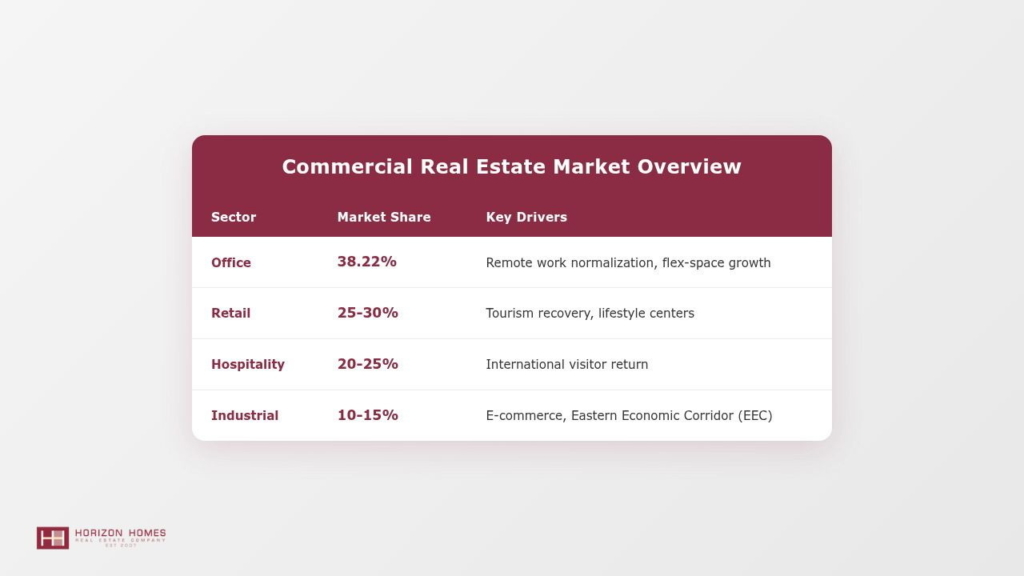
Thailand Board of Investment (BOI) incentives continue channeling capital into targeted sectors, with hospitality receiving preferential treatment for qualified operators. For capital markets participation, note the Stock Exchange of Thailand (SET) landscape and the role of hospitality-linked REITs for institutional exposure.
Regional Performance Comparison
Bangkok vs. Phuket vs. Koh Samui commercial markets reveal distinct risk-return profiles:
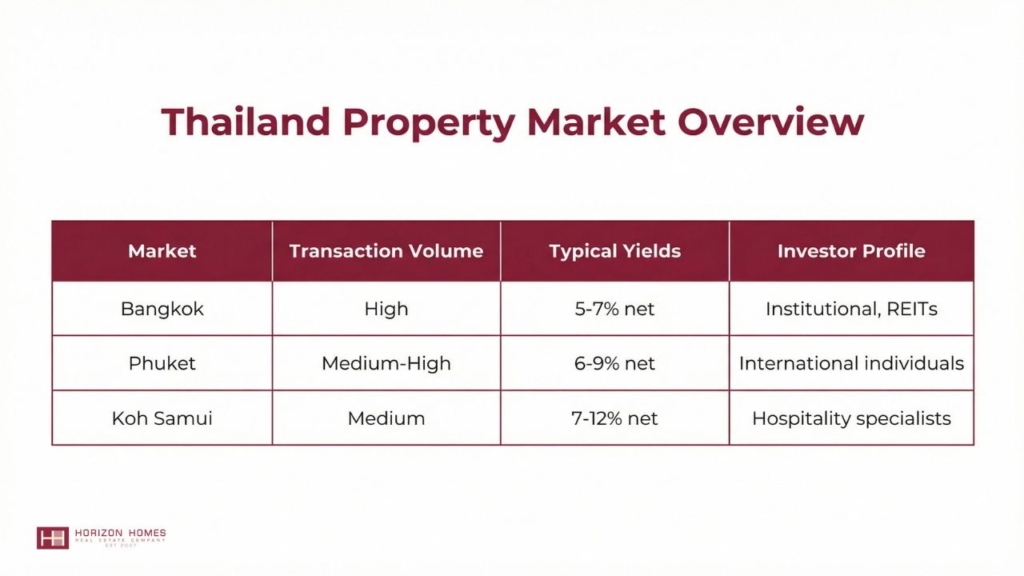
Koh Samui’s smaller market size translates to higher yields but reduced liquidity compared to Bangkok’s deep capital markets or Phuket’s established tourist infrastructure. The island appeals to investors prioritizing cash flow over quick exits.
Koh Samui Hospitality Market Deep Dive
Investment Volume and Sector Breakdown
Koh Samui has seen THB 30.98 billion invested in commercial real estate from 2020-2025, with hospitality capturing 25% of total investment volume (THB 7.75 billion). This sector concentration reflects the island’s tourism-dependent economy, as also profiled by C9 Hotelworks and PATA (Pacific Asia Travel Association) regional insights.
Commercial sector breakdown:
- Hospitality (hotels, resorts, villas): THB 7.75 billion (25%)
- Commercial buildings (retail, restaurants): THB 3.10 billion (10%)
- Other commercial: remaining 65%
Hotel and Resort Transaction Landscape
The market currently lists 49 hotels for sale in Koh Samui, with median transaction values around THB 18.2 million (Mordor Intelligence). This inventory provides meaningful selection for serious buyers.
Transaction opportunity categories:
- Operational hotels: Running businesses with staff, systems, and bookings
- Development sites: Land with permits for hospitality construction
- Turnkey operations: Fully furnished properties ready for immediate rental
- Management-in-place: Existing operations with professional operators
Each category carries distinct risk profiles and return expectations. Operational hotels provide immediate income but include staffing liabilities; turnkey properties reduce operational complexity but command premium pricing. Alignment with Thai Hotels Association (THA) best practices and adherence to the Hotel Act B.E. 2547 (2004) can materially impact licensing continuity and valuation.
Financial Performance: Commercial Property Yields
Verified Yield Analysis
Commercial property yields in Koh Samui exceed residential returns, though operational complexity increases proportionally. Analysis of verified transactions reveals the following net yield framework (Mordor Intelligence):
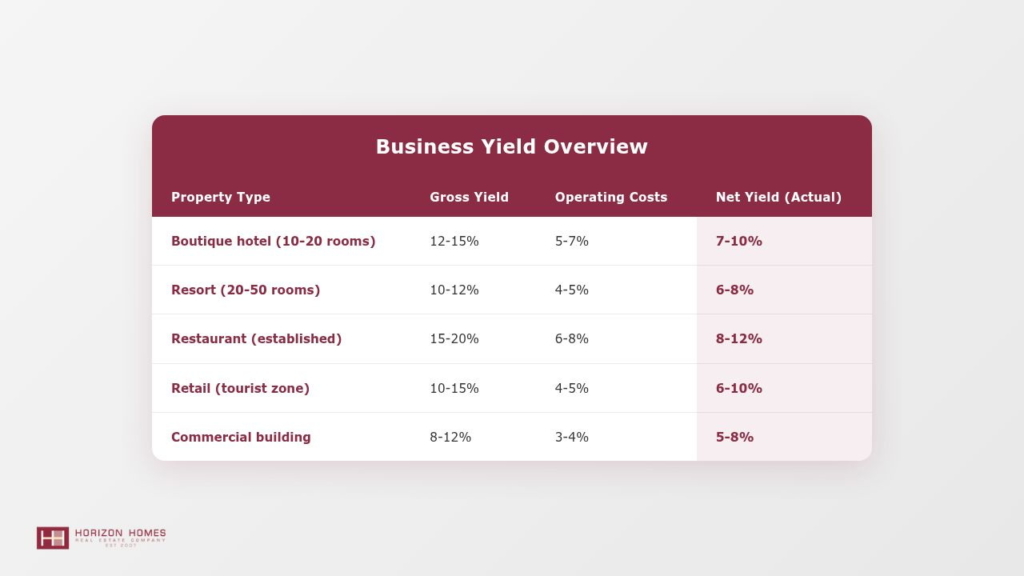
Operating costs for hospitality properties include:
- Staff wages and benefits (typically 25-35% of revenue)
- Utilities and consumables (10-15% of revenue)
- Marketing and distribution fees (15-25% of revenue via OTAs such as Booking.com, Agoda, Expedia, and villas via Airbnb; metasearch via Google Hotel Ads and Tripadvisor)
- Maintenance and repairs (5-8% of revenue)
- Insurance and licenses (2-3% of revenue)
- Management fees (if outsourced): 8-12% of revenue
Operational performance is heavily influenced by the tech stack: Property Management Systems like Oracle Hospitality OPERA or Cloudbeds, channel management via SiteMinder, and revenue management systems such as IDeaS or Duetto.
Capital Appreciation Patterns
Historical appreciation of 8-12% annually reflects recovery dynamics from pandemic disruption (Mordor Intelligence). Post-COVID demand analysis reveals several structural shifts affecting future appreciation:
- Premium experiential hospitality: Unique properties with strong identity commanding higher rates
- Digital nomad accommodation: Extended-stay products capturing new demand segments
- Wellness tourism: Properties with spa and health facilities outperforming commodity hotels, aligned with standards from the Global Wellness Institute (GWI) and medical partnerships with JCI-accredited providers
The 5.5 million visitors in 2023 (projected 6 million by 2025) provide demand foundation, though visitor demographics have shifted toward experience-seeking travelers willing to pay premium rates for distinctive properties (Mordor Intelligence).
Buying Hotels in Koh Samui: Due Diligence Framework
Pre-Transaction Investigation
Commercial transactions require systematic due diligence exceeding residential standards. Our recommended framework:
1. Title and Ownership Verification
- Confirm Chanote title or Nor Sor 3 Gor with upgrade potential
- Verify no encumbrances, liens, or pending litigation with the Land Department
- Confirm Foreign Business Act compliance for ownership structure (Mordor Intelligence)
- Review any existing lease agreements (30+30+30 structures) in context of the Civil and Commercial Code and document procedures with the Department of Business Development (DBD)
2. Operational Audit
- Historical financial statements (minimum 3 years)
- Booking data verification across platforms (Booking.com, Agoda, Expedia, Airbnb)
- Staff contracts and pending liabilities
- Maintenance records and capital expenditure history
- License and permit currency (hotel license per Hotel Act B.E. 2547, alcohol permits via Excise Department, food safety with Thai FDA)
3. Market Positioning Analysis
- Competitive set performance comparison
- Online reputation metrics (reviews, ratings, response quality)
- Distribution channel dependency (OTA vs. direct booking mix)
- Seasonality patterns and mitigation strategies
4. Financial Modeling
- Replacement cost analysis vs. asking price
- Multiple scenarios for occupancy and ADR assumptions
- Debt service coverage analysis (if financing)
- Exit strategy mapping (resale timeline, buyer profiles)
Structural Considerations for Commercial Purchases
Thai limited company structures remain the standard vehicle for foreign commercial property ownership, requiring careful drafting to ensure compliance with the Foreign Business Act (Mordor Intelligence).
Key structural requirements:
- Minimum 3 shareholders
- 51% Thai ownership mandatory
- Company purpose clauses must permit commercial activities
- Annual accounting and statutory filing compliance
Leasehold commercial structures offer simpler ownership with 30-year renewable terms. The 2024 Supreme Court ruling clarifying leasehold renewal procedures provides stronger legal standing for long-term leasehold arrangements.
Restaurant and Retail Commercial Opportunities
Buying Restaurants in Koh Samui
Restaurant businesses present unique commercial investment opportunities with different risk-return dynamics than hospitality:
Entry-level opportunities:
- Small restaurants in tourist zones: THB 2-5 million
- Mid-market dining: THB 5-15 million
- Established beachfront venues: THB 15-40 million
Key due diligence for restaurant acquisitions:
- Lease terms and remaining duration
- Alcohol license transferability
- Staff continuity and key person dependencies
- Equipment condition and replacement reserves
- Location-specific foot traffic patterns
Restaurants typically offer higher yields than hotels due to lower capital requirements, though income volatility and key-person risk require careful management.
Retail Property Considerations
Commercial buildings for sale in Koh Samui include retail spaces in established tourist areas. Key considerations:
- Foot traffic patterns (high season vs. annual averages)
- Anchor tenant stability (e.g., national chains such as CP ALL’s 7‑Eleven)
- Lease expiration profiles
- Conversion potential (residential to commercial, or vice versa)
BOI Incentives and Investment Structuring
Thailand Board of Investment Eligibility
BOI promotional privileges provide meaningful tax and operational benefits for qualified commercial investments. For investor support, use the One Start One Stop Investment Center (OSOS) under BOI.
Available incentives:
- Corporate income tax exemption (3-8 years depending on activity)
- Import duty reduction on machinery and raw materials
- Work permit facilitation for foreign personnel
- Land ownership permissions (in certain zones)
Qualifying activities for Koh Samui:
- International-standard hotel construction
- Certified wellness and medical tourism facilities
- Environmental management systems (ISO 14001, LEED, EDGE)
- Technology-enabled property management
Application Process
BOI applications typically require:
- Detailed business plan and financial projections
- Environmental impact assessment with ONEP (EIA where required)
- Location-specific feasibility analysis
- Employment and training commitments
- Technology transfer plans (for advanced manufacturing)
Working with experienced BOI advisors accelerates approval timelines and improves application quality.
Post-COVID Demand Analysis: What Changed
Visitor Behavior Shifts
The pandemic catalyzed structural changes in Koh Samui’s visitor base (Mordor Intelligence):
- Extended stays: Average length of stay increased from 4.2 nights (2019) to 6.8 nights (2024)
- Premium positioning: Higher-spending travelers recovered first, skewing demand toward quality operators
- Direct booking growth: Guest loyalty programs and direct booking increased post-pandemic
- Wellness integration: Health-conscious travelers seeking properties with fitness, spa, and healthy dining
Demand Projections
Tourism Authority of Thailand (TAT) projections suggest 6 million annual visitors by 2025, building toward pre-pandemic growth trajectories (Mordor Intelligence). Key drivers:
- Expanded flight routes (particularly Middle East and Indian markets) via Bangkok Airways into Samui (IATA: USM) and regional access upgrades by Airports of Thailand (AOT)
- MICE (meetings, incentives, conferences, exhibitions) recovery, supported by TCEB
- Medical and wellness tourism specialization with JCI-aligned providers
- Digital nomad visa programs attracting remote workers, including the Long-Term Resident (LTR) Visa and SMART Visa pathways
Off-Market Commercial Opportunities
Unlike residential markets, significant commercial transactions occur off-market. Our network provides access to:
- Distressed sales: Properties under financial pressure, often available 15–25% below market
- Developer inventory: Unsold units from completed projects seeking bulk buyers
- Owner-direct opportunities: Sellers preferring discreet transactions outside public listings
- Portfolio opportunities: Multiple properties available as combined packages
Off-market access requires relationship-based networking rather than public search. Our hospitality specialists maintain active relationships with property owners, banks, and other intermediaries surfacing these opportunities, alongside institutional brokers such as Knight Frank Thailand, Savills Thailand, CBRE, and JLL.
Management Partnership Frameworks
Professional Operator Selection
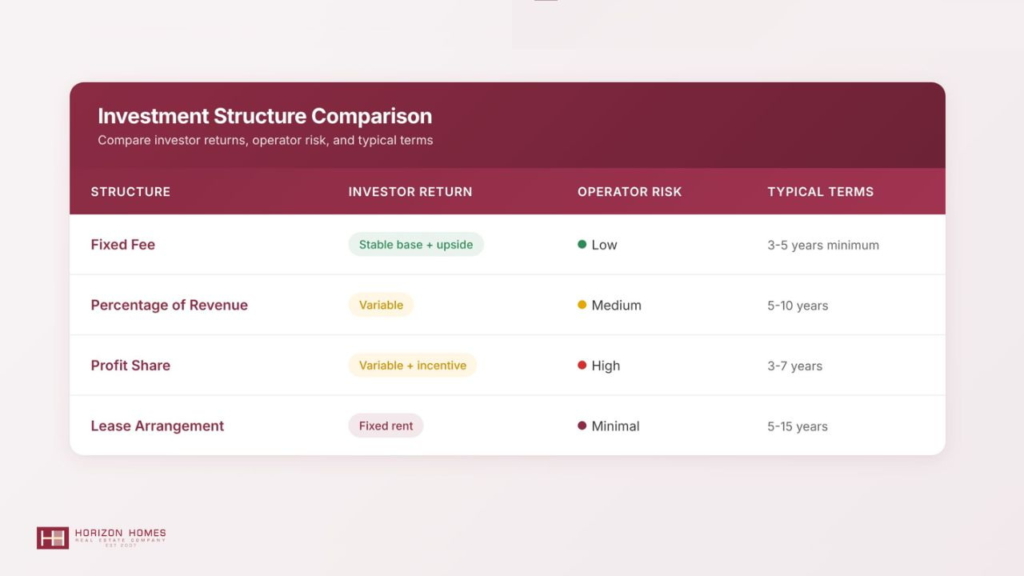
For investors lacking hospitality experience, management partnerships provide operational expertise while preserving ownership benefits. Frameworks can be adapted for brand-affiliated programs from Marriott International, Accor, Minor Hotels, and Centara Hotels & Resorts:
Management contract structures:
Vetted Partnership Criteria
We maintain relationships with management operators meeting rigorous criteria:
- Minimum 5 years Koh Samui operational experience
- Verified financial statements and references
- Technology infrastructure (PMS like Oracle OPERA/Cloudbeds, channel manager SiteMinder, revenue tools IDeaS/Duetto)
- Staff training and development programs
- Marketing and distribution capabilities
- Transparent reporting and accounting practices
Currency and Exit Strategy Considerations
Currency Risk Management
Thai Baht volatility affects returns for foreign investors. Strategies include:
- Natural hedging (Thai-sourced income and expenses)
- Forward contracts for major transactions
- Holding core assets in USD or EUR
- Timing larger payments to favorable exchange periods
Exit Strategy Mapping
Realistic exit timelines for Koh Samui commercial:
- Boutique hotel (10-20 rooms): 3-5 years to meaningful profit
- Resort (20-50 rooms): 5-7 years for optimal returns
- Commercial building: 7-10 years for full value realization
- Restaurant: 2-4 years (higher turnover, lower ultimate value)
Buyer profiles by property type:
- Boutique hotels: Individual international investors, small funds
- Resorts: Institutional capital, hotel chains
- Restaurants: Entrepreneurs, lifestyle buyers
- Commercial buildings: Thai institutions, family offices
Due Diligence Checklist for Commercial Investors
Due Diligence Checklist for Commercial Investors
Before committing to any commercial purchase:
- Complete title and encumbrance verification with the Land Department
- Financial statement audit (3-year minimum) and tax review with the Revenue Department
- License and permit verification (all applicable categories; Hotel Act B.E. 2547, Excise Department alcohol permit, Thai FDA food safety)
- Staff contract and liability assessment
- Competitive positioning analysis using STR (CoStar) or HVS
- Management structure evaluation (if applicable)
- BOI eligibility assessment and OSOS routing
- Lease agreement review (if purchasing leased property)
- Environmental compliance verification and EIA with ONEP
- Tax payment history (corporate and property)
- Insurance coverage and claims history
- Technology infrastructure assessment (OPERA, Cloudbeds, SiteMinder, IDeaS/Duetto)
- Independent valuation per RICS/TVA standards
Conclusion
Thailand’s commercial property landscape—particularly in Koh Samui—continues to offer strong opportunities for investors seeking higher-yield, hospitality-driven assets. With proven transaction volumes, increasing tourism demand, and evolving visitor behavior favoring premium experiences, the island remains a strategic entry point for those looking to diversify into koh samui properties with both income and long-term appreciation potential. However, as highlighted throughout this guide, success depends on careful due diligence, the right ownership structure, and a clear understanding of operational realities in this market.
At Horizon Homes Koh Samui, we go beyond listings by providing end-to-end guidance tailored to commercial and hospitality investments. From sourcing off-market opportunities to connecting you with vetted operators and structuring your investment correctly, our team ensures you are positioned for sustainable returns in this competitive landscape. Whether you are entering the market for the first time or expanding an existing portfolio, Horizon Homes Koh Samui serves as your trusted partner in securing high-performing property investments on the island.
References
- Mordor Intelligence Thailand Commercial Real Estate Market Report 2025
- Cushman & Wakefield Thailand Market Overview
- CBRE Thailand Hospitality Report
- JLL Thailand Commercial Property Bulletin
- C9 Hotelworks Koh Samui Hospitality Analysis
- Thailand Board of Investment (BOI) Official Publications
- Tourism Authority of Thailand (TAT) Visitor Statistics
Frequently Asked Questions
How to buy a hotel in Koh Samui?
Purchase requires systematic due diligence, appropriate legal structure (typically Thai limited company), and operational planning. Key steps: identify target properties, conduct financial and legal audit, structure ownership compliant with Foreign Business Act, negotiate purchase terms, complete transfer with all licenses transferred to new entity, establish management framework. Budget 3-6 months from initial interest to closing.
What commercial property yields can investors expect in 2026?
Net yields range from 6-8% for resort properties to 8-12% for well-managed restaurants and boutique hotels. Yields vary significantly based on property condition, management quality, location, and season mix. Properties requiring operational improvement offer upside potential but lower initial yields.
Best commercial investments in Koh Samui for foreign investors?
Boutique hotels in Chaweng and Bophut offer the strongest combination of yield and liquidity. Established restaurants in tourist zones provide higher yields with lower capital requirements. Commercial buildings in emerging areas (Maenam, Bang Po) offer value opportunities as infrastructure improves.
Foreign ownership of commercial property Thailand: what are the rules?
Foreign ownership of commercial land requires Thai company structure or leasehold arrangement. Companies must comply with Foreign Business Act requirements including 51% Thai ownership. Condominiums may be owned freehold up to 49% foreign quota. Ensure company registration with DBD, tax compliance with the Revenue Department, and licensing per the Hotel Act B.E. 2547. Working with experienced Thai commercial lawyers is essential.
Thailand commercial property market vs. residential: key differences?
Commercial properties typically offer higher yields (6-12% vs. 5-8% residential) but require more operational involvement or professional management. Transaction costs are higher (transfer fees, business taxes) and liquidity is lower. Commercial leases provide more stable rental income but require business acumen to manage successfully.
How has post-COVID demand affected Koh Samui hospitality investments?
Recovery has been strong, with 5.5 million visitors in 2023 approaching pre-pandemic levels and 6 million projected for 2025. Demand has shifted toward premium experiential properties while mid-market operators face pressure. Extended stays and wellness-focused properties outperform commodity hotel categories.
What management structures work best for non-resident investors?
Management contracts with experienced local operators provide the smoothest path for non-resident owners. Fixed-fee structures offer stability; profit-sharing arrangements align incentives. Lease arrangements minimize owner involvement but yield lower returns. Consider brand-aligned options with Accor, Marriott International, Minor Hotels, or Centara Hotels & Resorts, and ensure enabling tech stack (OPERA/Cloudbeds, SiteMinder, IDeaS/Duetto).
Are off-market commercial properties available in Koh Samui?
Yes, significant commercial transactions regularly occur off-market through relationship networks. Distressed sales, developer inventory, and owner-direct opportunities provide access to properties unavailable through public listings. Our commercial network and partners including Knight Frank Thailand, Savills Thailand, CBRE, and JLL surface these opportunities for qualified buyers.
Thailand hospitality investment outlook beyond 2026?
Long-term fundamentals support continued growth: airport expansion improving accessibility, BOI incentives channeling capital, EEC development benefiting regional connectivity. Short-term volatility from global economic conditions and tourism seasonality creates entry opportunities for disciplined investors with 5-7 year time horizons.
What are the risks of commercial property investment in Koh Samui?
Key risks include: seasonal occupancy fluctuations (60-70% Nov-Mar concentration), currency volatility, foreign ownership complexity, operator dependency for non-operating investors, and liquidity constraints in secondary locations. Successful investors mitigate these through proper structuring, professional management, and realistic yield expectations.