Setting the right rental rate for a Koh Samui villa can be difficult, especially when demand changes between peak season, high season, shoulder season, and low season. A villa that is priced too high may sit empty for weeks. A villa that is priced too low may fill quickly but lose thousands of baht in missed income.
Victor learned this the hard way. His luxury five-bedroom beachfront villa in Lamai had been empty for three weeks, and the booking inquiries had almost stopped. He kept changing the price every few days, but nothing seemed to work. At one point, he dropped the rate to 35,000 THB per night and still received no bookings. The week before, he had listed it at 55,000 THB, and a guest asked if the price was serious.
Victor’s problem is common in Koh Samui’s vacation rental market. Pricing a villa is not just about copying a competitor or guessing what guests might pay. It requires understanding seasonal demand, property type, booking platforms, guest behaviour, operating costs, and local market benchmarks.
This guide explains how villa owners can set rental rates in Koh Samui using a more structured, data-driven approach. It covers seasonal pricing, base rate calculation, dynamic pricing, platform strategy, currency decisions, local demand factors, and tools that can help owners maximise rental revenue.
If you need support managing pricing, bookings, guest service, and maintenance, We also offer Koh Samui property management services for villa owners who want a more hands-off rental strategy.
Why Rental Pricing Matters in Koh Samui
Koh Samui has a competitive rental market with a wide range of properties, from budget villas to ultra-luxury beachfront estates. Guests compare listings across Airbnb, Booking.com, Agoda, direct rental websites, and local agencies before making a decision.
A strong pricing strategy helps villa owners:
- Increase occupancy during slower periods
- Maximise nightly revenue during peak demand
- Avoid unnecessary discounting
- Compete more effectively across platforms
- Improve annual rental yield
- Protect long-term property value
- Build a more predictable rental income stream
Pricing should not stay the same all year. Koh Samui’s rental market changes significantly depending on weather, holidays, flight availability, international travel trends, and local events. Owners who adjust pricing based on demand are more likely to outperform owners who rely on fixed rates.
Understanding Koh Samui’s Seasonal Demand Patterns
Koh Samui’s tourism flows do not follow a simple summer and winter pattern. Demand is shaped by international school holidays, Christmas and New Year travel, Thai festivals, Chinese New Year, weather conditions, and regional travel trends.
For villa owners, the easiest way to understand rental demand is to divide the year into four pricing seasons.

The Four-Season Framework for Koh Samui Rentals
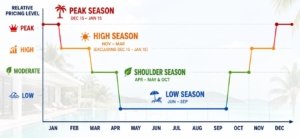
Peak Season: December 15 to January 15
Peak season is the strongest rental period in Koh Samui. It overlaps with Western Christmas holidays, New Year travel, and the busiest international holiday window.
During this period, many villa categories can reach very high occupancy. Luxury properties, beachfront villas, and large family villas can command major price premiums if they are marketed properly.
Pricing Strategy for Peak Season
During peak season, villa owners should avoid underpricing. Guests are often willing to pay more for quality villas, especially when supply is limited.
Peak season pricing may include:
- Higher nightly rates
- Longer minimum stays
- Stricter cancellation terms
- Limited discounting
- Higher security deposits for luxury properties
- Clear check-in and checkout rules
For example, a villa that could earn 80,000 THB per night during peak season but is listed at 50,000 THB may lose 30,000 THB per booked night. Over one week, that could mean 210,000 THB in missed revenue.
High Season: November to March, Excluding Peak
High season covers most of the dry season and attracts international travellers escaping colder climates. Demand is still strong, although not as intense as Christmas and New Year.
Typical high-season guests include:
- European holidaymakers
- Australian families
- Digital nomads
- Retirees
- Couples
- Groups looking for villa stays
Pricing Strategy for High Season
High season rates are usually above base pricing but below peak-season premiums. Owners should focus on maintaining strong occupancy while still protecting nightly revenue.
Useful high-season tactics include:
- 2 to 3 night minimum stays
- Moderate price premiums
- Weekly rate packages
- Faster inquiry response times
- Updated listing photos
- Strong platform visibility
Shoulder Season: April to May and October
Shoulder season is a transition period between high demand and low demand. April includes Songkran, Thai New Year, which can create a short but intense demand spike. October can also see improving demand as the island moves toward the dry season.
Pricing Strategy for Shoulder Season
Shoulder season pricing should be flexible. Some weeks may perform well, while others may require more competitive rates.
Owners can use:
- Slightly reduced base rates
- Shorter minimum stays
- Limited-time promotions
- Last-minute discounts
- Monthly stay offers
- Flexible cancellation policies
Low Season: June to September
Low season usually brings the weakest demand of the year. Rainy-season weather, fewer international arrivals, and lower booking confidence can reduce occupancy. Well-positioned properties can still attract bookings, but pricing must be realistic.
Pricing Strategy for Low Season
Low season is not about matching peak-season revenue per night. The goal is to reduce empty nights and attract guests who are looking for value.
Low-season strategies include:
- Lower nightly rates
- 1 night minimum stays where suitable
- Monthly rental discounts
- Last-minute offers
- Added-value packages
- Flexible check-in options
- Promotion of quieter beaches, green scenery, and fewer crowds
Seasonal Pricing Summary
| Season | Typical Period | Demand Level | Suggested Pricing Approach |
| Peak Season | December 15 to January 15 | Very high | Strong premium pricing |
| High Season | November to March, excluding peak | High | Above base rate |
| Shoulder Season | April to May and October | Moderate | Flexible base pricing |
| Low Season | June to September | Low | Discounted and value-focused pricing |
Calculating Your Base Rate
Before applying seasonal adjustments, villa owners need a base rate. This is the starting nightly price before peak-season premiums, discounts, or dynamic pricing changes.
A base rate should reflect:
- Property size
- Location
- Bedroom count
- View quality
- Beach access
- Pool and amenities
- Operating costs
- Target annual return
- Competitor pricing
- Expected occupancy
Owners should not set a base rate only by looking at nearby listings. Competitor rates can be misleading because some properties may be underperforming, poorly managed, newly discounted, or positioned for a different guest type.
Key Rental Performance Metrics
Average Daily Rate
Average Daily Rate, or ADR, measures the average revenue earned per booked night.
Formula
Average Daily Rate = Total rental revenue ÷ Total booked nights
For example, if a villa earns 600,000 THB across 20 booked nights, the ADR is 30,000 THB.
Occupancy Rate
Occupancy rate measures the percentage of available nights that are booked.
Formula
Occupancy Rate = Booked nights ÷ Available nights × 100
For example, if a villa is available for 30 nights and books 18 nights, the occupancy rate is 60%.
Revenue Per Available Room
Revenue Per Available Room, or RevPAR, combines nightly rate and occupancy into one metric.
Formula
RevPAR = ADR × Occupancy Rate
RevPAR is useful because it shows whether a villa is truly performing well. A villa with a high nightly rate but low occupancy may earn less than a villa with a lower nightly rate and stronger occupancy.
How to Calculate a Base Rental Rate
Step 1: Calculate Annual Costs
Start by listing the annual costs of running the property.
Common villa costs include:
- Mortgage or financing costs, if applicable
- Insurance
- Property taxes
- Repairs and maintenance
- Pool maintenance
- Garden maintenance
- Electricity, water, internet, and TV
- Cleaning and linen
- Property management fees
- Platform fees
- Marketing and photography
- Replacement of furniture, appliances, and soft furnishings
If your villa is professionally managed, you should also include management fees. Check our guide on property management fees which helps owners understand how fees may vary depending on the property and service level.
Step 2: Set Your Target Net Income
After calculating costs, decide how much net annual income you want from the villa.
Your target income should consider:
- Cash flow needs
- Investment return expectations
- Property value
- Long-term appreciation
- Wear and tear
- Personal use of the villa
- Market risk
Step 3: Estimate Your Expected Occupancy
Occupancy will vary depending on the property and season. A villa that performs well in high season may still face lower demand during rainy months.
When estimating occupancy, be realistic. Overestimating occupancy can lead to a base rate that looks good on paper but fails in the real market.
Step 4: Work Backward to Find the Required ADR
Use the following calculation:
Required Annual Revenue = Target Net Income + Annual Costs
Required Booked Nights = 365 × Target Occupancy Rate
Required ADR = Required Annual Revenue ÷ Required Booked Nights
Example Base Rate Calculation
| Item | Example Amount |
| Target net income | 600,000 THB |
| Annual costs | 400,000 THB |
| Required annual revenue | 1,000,000 THB |
| Target occupancy | 50% |
| Required booked nights | 182 nights |
| Required ADR | Around 5,495 THB |
In this example, the villa needs to earn an average of around 5,495 THB per booked night to meet the owner’s annual target.
2026 Koh Samui Villa Rate Benchmarks
The table below gives a general pricing framework for Koh Samui villas. Actual pricing will vary depending on location, quality, views, bedroom count, amenities, property management, and platform performance.

| Villa Category | Low Season THB/Night | High Season THB/Night | Peak Season THB/Night |
| Budget, 2BR, no pool | 3,000 to 5,000 | 5,000 to 8,000 | 8,000 to 12,000 |
| Mid-range, 3BR, pool | 6,000 to 10,000 | 10,000 to 18,000 | 18,000 to 30,000 |
| Luxury, 4BR, sea view | 12,000 to 20,000 | 20,000 to 40,000 | 40,000 to 80,000 |
| Ultra-luxury, 5BR+, beachfront | 25,000 to 50,000 | 50,000 to 100,000 | 100,000 to 150,000+ |
These benchmarks assume standard amenities such as air conditioning, WiFi, basic cleaning between guests, and normal villa facilities. Additional charges may apply for extra beds, private chefs, airport transfers, early check-in, or special guest services.
Owners can also review current villas for rent in Koh Samui to compare how similar properties are positioned in the market.
Dynamic Pricing for Koh Samui Villas
Base rates are only the starting point. Dynamic pricing means adjusting rates based on demand, booking windows, availability, competitor pricing, seasonality, and guest behaviour.
A static yearly rate is usually not effective in Koh Samui because demand changes sharply throughout the year.
Platform Pricing Tools vs Manual Pricing
Many booking platforms offer automatic pricing tools. Airbnb Smart Pricing, Booking.com tools, and third-party platforms can suggest rates based on market demand.
These tools can be helpful, but villa owners should not rely on them completely.
What Automated Tools May Miss
Automated pricing tools may not fully understand:
- Songkran demand
- Chinese New Year demand
- Full Moon Party spillover
- Local weather conditions
- Flight price changes
- Road access issues
- New villa launches nearby
- Your property’s unique view, design, or privacy level
Recommended Pricing Approach
Use automated pricing tools as a starting point, then apply manual adjustments for local demand factors.
A strong approach includes:
- Reviewing pricing weekly during high season
- Increasing rates for strong demand periods
- Reducing rates for unsold dates close to arrival
- Adjusting minimum stays by season
- Comparing net revenue across platforms
- Tracking inquiry volume and conversion rates
Minimum Stay Requirements
Minimum stay rules affect both occupancy and profitability. Longer stays reduce cleaning costs and guest turnover, but they can also reduce flexibility.
Recommended Minimum Stay by Season
| Season | Suggested Minimum Stay | Reason |
| Peak Season | 3 to 7 nights | Protects revenue during strongest demand |
| High Season | 2 to 3 nights | Balances occupancy and turnover |
| Shoulder Season | 2 nights | Keeps the property flexible |
| Low Season | 1 night where suitable | Helps capture last-minute bookings |
Luxury villas may use longer minimum stays during peak periods, especially when families or groups are likely to book for one week or more.
Last-Minute and Extended Stay Discounts
Discounting should be strategic. A discount can help fill empty nights, but too much discounting can damage perceived value.
Last-Minute Discounts
For dates within 7 days of arrival, owners can consider a 10% to 15% discount if the villa is still empty.
A discounted booking is usually better than an empty night, as long as the rate covers variable costs and does not create operational issues.
Extended Stay Discounts
Guests staying 14 nights or more may expect a discount. For monthly stays, owners often offer larger reductions because the booking provides stability and reduces turnover.
Common extended stay discounts:
| Stay Length | Possible Discount |
| 7 nights | 5% to 10% |
| 14 nights | 10% to 20% |
| 30 nights or more | 20% to 30% |
Monthly Rate Calculation
A simple way to calculate a monthly rate is:
Monthly Rate = Nightly Rate × 25
This gives the guest a discount compared with paying the full nightly rate for 30 days.
For example, a villa priced at 50,000 THB per night may offer a monthly rate of around 1,250,000 THB before further negotiation.
Platform Strategy for Villa Owners
Koh Samui villa owners often receive bookings from multiple channels. No single platform captures the entire market, so it is usually better to use a multi-channel strategy.
Main Booking Channels in Koh Samui
Airbnb
Airbnb is popular with international travellers, families, digital nomads, and guests looking for private villa stays. It is useful for properties with strong photography, good reviews, and clear guest communication.
Booking.com
Booking.com can perform well with European travellers and guests who prefer hotel-style booking experiences. It may also attract higher-intent travellers who are ready to book quickly.
Agoda
Agoda is useful for reaching Asian markets, including travellers from Singapore, Malaysia, Korea, China, and Thailand.
Direct Bookings
Direct bookings can be highly profitable because they avoid platform commissions. However, they require trust, strong marketing, a professional website, and reliable guest communication.
Platform Fee Comparison
When comparing platforms, owners should look at net revenue, not only gross booking value.
| Platform | Example Commission | Gross Booking | Estimated Net Revenue |
| Airbnb | 3% | 50,000 THB | 48,500 THB |
| Booking.com | 12% | 50,000 THB | 44,000 THB |
| Agoda | 12% | 50,000 THB | 44,000 THB |
| Direct | 0% | 50,000 THB | 50,000 THB |
A direct booking at a lower gross rate may still outperform a platform booking after commission is deducted.
Cross-Platform Listing Strategy
Managing multiple booking platforms requires organisation. Owners should avoid double bookings, inconsistent rates, and slow inquiry responses.
Best Practices
- Use a channel manager to sync calendars
- Keep pricing consistent across platforms
- Update availability immediately
- Respond to inquiries quickly
- Use professional photos
- Keep descriptions accurate
- Track platform performance monthly
- Compare net revenue, not just booking volume
Currency Strategy: THB vs USD Pricing
Because Koh Samui attracts international guests, currency strategy can affect both guest perception and owner profitability.
Pricing in THB
Most local costs are paid in Thai Baht, so THB pricing makes financial tracking easier.
Benefits of THB Pricing
- Matches local expenses
- Easier for Thai guests and local managers
- Reduces conversion confusion
- Works well on local property platforms
Pricing in USD
USD pricing may appeal to some international guests, especially those comparing luxury villas across global destinations.
Benefits of USD Pricing
- Familiar for international travellers
- Can support premium positioning
- May reduce confusion for guests used to USD comparisons
Practical Currency Recommendation
For most villa owners, a mixed approach works best.
Use:
- THB pricing on Airbnb and Booking.com
- THB pricing for local expenses and profitability tracking
- THB and USD pricing on direct booking websites where possible
- Clear exchange rate information for international guests
Thailand-Specific Factors That Affect Rental Rates
Koh Samui pricing is influenced by several local factors that may not appear in standard pricing tools.

Thai Holiday Calendar
Songkran
Songkran takes place in April and can create a short demand spike. Both domestic and international travellers may look for villas during this period.
Owners can consider pricing above standard shoulder-season rates during Songkran.
Chinese New Year
Chinese New Year usually falls between late January and February. Demand can increase from Chinese travellers, regional tourists, and diaspora families.
High-end villas and beachfront properties may perform especially well during this period.
Loy Krathong
Loy Krathong in November can create a modest increase in demand. It is not usually as strong as Songkran or Christmas, but it may support higher rates in certain areas.
Weather and Rainy Season Risk
Low season overlaps with the rainy season. Rain does not always last all day, but the perception of bad weather can reduce international bookings.
Low-Season Pricing Tips
- Avoid peak-season pricing
- Promote quieter beaches and lower crowds
- Offer flexible stays
- Use value-added packages
- Consider monthly rental options
- Keep cancellation policies guest-friendly where possible
Flight Access and Travel Costs
Koh Samui’s airport is convenient but flight prices can affect guest budgets. If flights to Koh Samui are expensive, some travellers may reduce their accommodation budget or choose another island.
Owners should monitor:
- Flight prices
- School holiday travel periods
- Major regional holidays
- Airline schedule changes
- Bangkok to Koh Samui connections
Tools for Managing Dynamic Pricing
Modern rental pricing can be easier with tools that monitor demand, competitor rates, and booking patterns.
Useful Pricing and Management Tools

Airbnb Smart Pricing
Airbnb Smart Pricing is free for hosts and can adjust prices based on platform demand. It is a useful starting point but should be reviewed manually.
Beyond Pricing
Beyond Pricing provides dynamic pricing recommendations based on market data. It can be useful for short-term rental owners who want more automated rate suggestions.
Wheelhouse
Wheelhouse offers daily pricing recommendations and analytics for short-term rental properties.
Guesty
Guesty helps with channel management, operations, automation, and pricing support for property managers and owners.
Lodgify and Beds24
These tools can help with calendar syncing, booking management, and direct booking setup.
Manual Pricing Checks Owners Should Still Do
Even with software, owners should review pricing manually.
Check:
- Competitor listings
- Inquiry volume
- Booking lead time
- Occupancy rate
- Guest reviews
- Platform ranking
- Upcoming holidays
- Flight demand
- Local events
- Maintenance gaps between bookings
Common Pricing Mistakes Villa Owners Should Avoid
Copying Competitor Rates Blindly
Competitor prices do not always reflect actual bookings. Some villas may be overpriced, discounted, poorly managed, or receiving no inquiries.
Keeping the Same Rate All Year
Koh Samui has strong seasonal changes. A fixed yearly price can lead to underpricing in peak season and overpricing in low season.
Ignoring Platform Fees
A booking that looks profitable on paper may be weaker after commission is deducted. Always calculate net revenue.
Discounting Too Early
Dropping prices too early can train guests to wait for discounts. Use discounts strategically, especially for last-minute gaps.
Ignoring Minimum Stay Rules
Minimum stay settings can block bookings if they are too strict during low season. They can also reduce revenue if they are too loose during peak season.
Not Tracking Performance
Owners should track ADR, occupancy, RevPAR, inquiry volume, and booking conversion. Without data, pricing decisions become guesswork.
Rental Pricing Checklist for Koh Samui Villa Owners
Before setting or changing your villa rate, review this checklist:
- Have you calculated annual costs?
- Have you set a target net income?
- Have you estimated realistic occupancy?
- Have you calculated your required ADR?
- Have you checked similar villas in your area?
- Have you adjusted for seasonality?
- Have you reviewed minimum stay rules?
- Have you accounted for platform fees?
- Have you checked upcoming holidays?
- Have you reviewed last-minute gaps?
- Have you compared net revenue by platform?
- Have you updated your listing photos and description?
Conclusion
Setting rental rates in Koh Samui is not a one-time task. It is an ongoing process that requires market observation, data tracking, seasonal awareness, and regular adjustment. Villa owners who treat pricing as a dynamic strategy are more likely to improve occupancy, protect nightly revenue, and increase annual returns.
Start with a clear base rate, compare it against similar Samui real estate, adjust by season, and track performance over time. As your data improves, your pricing decisions will become more accurate and less dependent on guesswork.
For villa owners who want professional support, we, at Horizon Homes can help with pricing strategy, rental management, guest communication, and long-term property performance. A strong pricing approach can make a major difference in the competitive Samui real estate market, especially for owners who want their villa to earn its full potential.
Frequently Asked Questions
How do I determine the right rental rate for my Koh Samui villa?
Start by calculating annual costs, target net income, and expected booked nights. Then divide your required annual revenue by your expected booked nights to find your required average daily rate. After that, compare your rate with similar villas in the same location and property tier.
When should I raise rates during peak season?
You should raise rates when demand is strong, booking lead times are short, or your calendar is filling earlier than expected. If guests are booking far in advance during high-demand periods, your current rate may be too low.
How much should I discount during low season?
Low-season discounts of 20% to 40% below high-season rates are common, depending on the property and market conditions. The goal is to improve total annual revenue by reducing empty nights during weaker demand periods.
Should I use dynamic pricing tools?
Yes, dynamic pricing tools can help, but they should not replace manual judgment. Koh Samui has local events, weather patterns, and holiday spikes that automated tools may not fully understand.
How do minimum stay requirements affect pricing?
Minimum stay requirements affect both occupancy and turnover costs. Longer minimum stays work better during peak season, while shorter minimum stays can help attract bookings during low season.
What is the difference between ADR and RevPAR?
ADR measures average revenue per booked night. RevPAR measures revenue across all available nights by combining rate and occupancy. RevPAR is often more useful because it shows overall property performance.
How do I price extended stays or monthly rentals?
For stays of 30 days or more, many owners offer a 20% to 30% discount from the nightly rate. A simple method is to multiply the nightly rate by 25 instead of 30 to create a monthly rate.
Which booking platform should I prioritise?
Airbnb, Booking.com, Agoda, and direct bookings can all be useful. Airbnb is often strong for private villa stays, while Booking.com and Agoda can help reach different international markets. Direct bookings are usually the most profitable if you have enough trust and visibility.
Should I list my villa in THB or USD?
For most owners, THB pricing works best because local expenses are usually paid in Thai Baht. Direct booking websites can show both THB and USD to help international guests compare prices.
Should I match competitor pricing?
No, you should not blindly match competitor pricing. Use competitors as context, but price based on your villa’s location, quality, views, amenities, reviews, operating costs, and target return.