Buying commercial property is, at its core, a search-and-verification problem: find an asset whose location, type, condition, lease structure, and legal title fit your business model *and* survive a realistic 2026–2030 outlook. Most “how to choose commercial property” guides online treat it as a generic finance problem with American mortgages and US zoning. This guide does something different.
We combine the universal 8-factor checklist every commercial buyer should use, the same framework you would apply in New York, London, or Singapore, with the Thailand-specific realities that actually govern a deal in Koh Samui: foreign-ownership rules, freehold-versus-leasehold trade-offs, title-deed security, due-diligence sequencing, and the micro-market dynamics of Chaweng, Bophut, Lamai, Choeng Mon, and Maenam. By the end, you will have a decision framework you can use to evaluate any Thailand commercial deal, and a checklist to take into your next property viewing.
Thailand’s commercial real estate market is projected at USD 19.02 billion in 2026, growing to USD 25.03 billion by 2031 at a 5.6% CAGR. Tourism-heavy destinations like Koh Samui absorb a disproportionate share of that growth. Whether you are a Samui-based operator expanding your footprint, a foreign investor searching for samui real estate for sale to anchor a beach-club or boutique-hotel thesis, or a Thai family acquiring commercial assets for income, the framework below is your starting point.
The 8 Universal Factors When Choosing Commercial Property

These eight factors apply globally. They are the criteria underwriting analysts use at REITs, banks, and pension funds to assess any commercial real estate deal. Master them and you can evaluate any property in any country.
| Factor | What to Look For | Why It Matters |
| Location | Foot traffic, visibility, accessibility | Drives 60–80% of commercial value |
| Demographics | Catchment population, spending power | Determines customer base & rent levels |
| Accessibility | Roads, parking, public transit, airport proximity | Determines convenience ceiling |
| Size & Layout | Usable sqm, ceiling height, loading access | Limits tenant uses |
| Building Condition | Roof, HVAC, electrical, plumbing | Major capex risk if deferred |
| Lease Terms (if leased) | Length, rent escalation, renewal options | Determines tenant stability & exit |
| Operating Expenses | Property taxes, insurance, CAM, mgmt fees | Affects net yield directly |
| Growth Potential | Future development, area trends, zoning | Drives appreciation + rent uplift |
Location is the single largest value-driver. A Class B building on Main Street beats a Class A building on a side street every time. Always visit at two different times of day (peak and quiet hours) to validate foot-traffic assumptions.
Demographics matter because commercial rent is driven by what the catchment area can support. A Koh Samui beachfront shop in Chaweng serves a tourist catchment measured in millions annually; a shop inland serves a local catchment measured in thousands. Both can work, but the pricing, lease length, and tenant mix differ dramatically.
Accessibility is underrated. Proximity to the airport (Samui International is in the north of the island), road quality, parking availability, and walking access from hotels/resorts all directly affect which tenants will consider the space.
Size and layout determine who can lease from you. A 200 sqm shop with low ceilings is fine for a café but rules out a restaurant needing kitchen extraction or a retail tenant needing tall shelving.
Building condition is where the biggest capex traps hide. Always commission a structural and mechanical inspection before purchase. The cost is $500–$2,000 and routinely saves $20,000–$100,000.
Lease terms matter for income-producing properties. Triple-net (NNN), gross, modified-gross, each allocates expenses differently and changes your effective yield.
Operating expenses should be itemized and compared to local benchmarks. CAM (common area maintenance) in tropical climates can surprise cold-climate buyers, mold, salt air, monsoon rain all accelerate wear.
Growth potential is the appreciation lever. Look for upcoming infrastructure (a new road, a new resort cluster, a zoning change), walkable proximity to anchor attractions, and zoning that permits your intended use.
A practical scoring matrix: weight each factor for your deal (e.g., for a beach club, location = 30%, lease = 10%; for a warehouse, accessibility = 25%, size = 25%) and score 1–5 on each. Aggregate to a pass/fail threshold before you go to offer.
Why Koh Samui Is Different: Thailand-Specific Considerations

The universal framework above is necessary but not sufficient for Thailand. Three structural realities override every Koh Samui commercial deal: foreign ownership restrictions, freehold-versus-leasehold trade-offs, and title-deed security.
Foreign Ownership Rules
Foreign individuals cannot own land in Thailand. Period. There is no workaround for freehold land ownership by a foreigner. What foreigners *can* do:
- Freehold of a condominium unit — under Section 19 of the Condominium Act, foreigners can own condo units freehold, subject to the building’s foreign quota (49% of total unit area). For commercial use, this is rarely the best fit unless the condo is zoned for mixed-use.
- 30-year leasehold (renewable) — the most common path for villa, land, and many commercial property acquisitions. Standard structure is 30+30+30 (an initial 30-year term plus two optional 30-year extensions). The initial lease is registered at the Land Department and creates a real property right. The 30-year extensions, when *contractually* included in the original lease, are enforceable against the landowner’s successors, but they are not statutorily guaranteed. Reputable developers structure 30+30+30 with airtight extension clauses and bond the extensions.
- Thai Limited Company — a company where 51% of voting shares are held by Thai nationals and the foreigner controls the *economic* interest through preferred shares is the standard structure for villa freehold ownership. For commercial properties where a foreign company itself holds the asset (e.g., a beach-club operating business), the structure is similar. Compliance costs are higher and ongoing, and the 51% Thai partner must be a genuine owner, nominee structures are illegal under Section 673 of the Civil and Commercial Code and increasingly scrutinized.
Freehold vs Leasehold: The Trade-Offs
| Attribute | Freehold (Thai Ltd Co) | Leasehold 30+30+30 |
| Upfront cost | Higher (typically 25–40% premium) | Lower (lease premium only) |
| Long-term control | Permanent (subject to company structure) | 90 years if extensions exercise |
| Exit liquidity | Higher — leasehold can be ~30% discount | Limited pool of foreign buyers |
| Financing | Harder for foreign-owned companies | Easier to negotiate owner financing |
| Compliance burden | Annual company filings, KYC, audit | Lease registration only |
The honest answer: leasehold 30+30+30 is the right answer for most foreign commercial buyers in Koh Samui. It is cheaper, simpler, and the extensions are routinely exercised in good standing. Freehold via Thai Limited Company is for buyers who have specific tax-planning, succession-planning, or 30+ year operational logic that justify the overhead.
Title Deeds: The Most Important Due-Diligence Step
Thailand has several types of land title:
- Chanote (Nor Sor 4 Jor) — full freehold title with surveyed boundaries, the gold standard, and the only type a serious buyer should accept for significant commercial transactions.
- Nor Sor 3 Gor — confirmed land rights with some boundary clarity, generally acceptable for smaller commercial deals when paired with a survey.
- Nor Sor 3 — paper-based, pre-survey, not directly tradable and should be avoided for any significant commercial investment.
- Sor Kor Nung — possessory right only, used for agriculture, never acceptable for commercial purchase.
Insist on a Chanote deed for any commercial purchase above ฿5 million. Verify the title at the Land Department, the same agency where the lease will be registered. The cost is a few hundred baht and 1–2 days; it is non-negotiable.
For a deeper walkthrough of the legal mechanics, see Horizon Homes’ complete guide to Thailand commercial real estate market structure and the owning vs leasing commercial property guide.
Koh Samui Micro-Market Breakdown
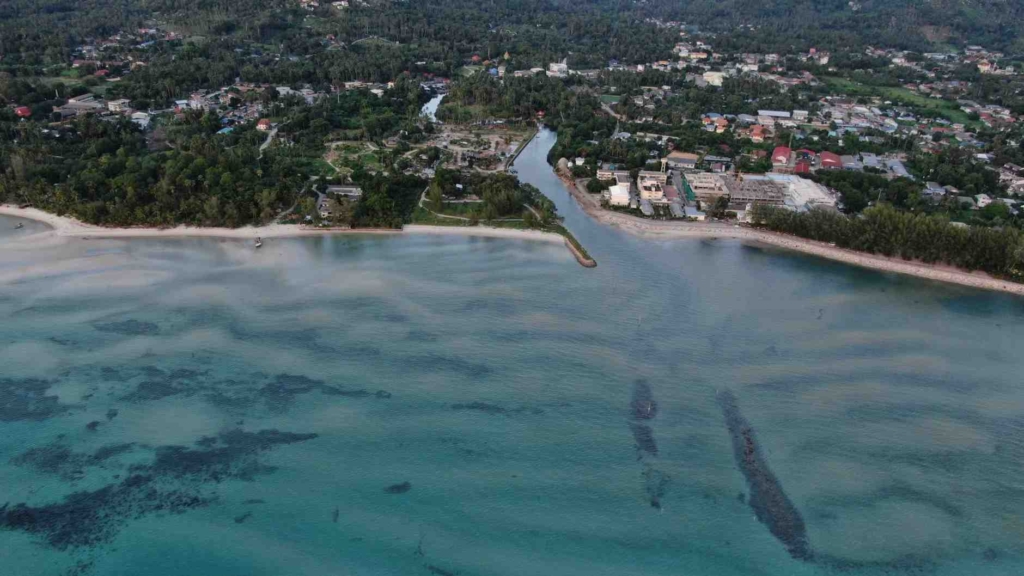
Samui is not one real estate market, it is five. Each sub-district has distinct tenant mix, foot-traffic profile, and price-per-sqm band. Choosing the wrong one is the single most common mistake foreign buyers make.
Chaweng. The commercial heart of Samui. Beach road frontage here commands the island’s highest retail and F&B rents. Tenant mix is dominated by international restaurants, beach clubs, tour operators, and nightlife. Foot traffic peaks November–March but holds year-round. Mid-2026 median list prices for Chaweng commercial: ~฿25,000–35,000 per sqm, with beach-road frontage at a 40–60% premium. Best for restaurants, beach clubs, retail, nightlife. See live examples in Chaweng’s commercial listings.
Bophut / Fisherman’s Village. Boutique retail and lifestyle-tenanted. The Friday-night Walking Street is one of Samui’s signature events. Tenant mix leans upscale: boutique hotels, design shops, brunch cafés, yoga studios, mid-luxury restaurants. Less volume than Chaweng but higher per-cover spending. Median list: ~฿18,000–28,000 per sqm. Best for boutique hotels, lifestyle retail, F&B with a slow-dining concept.
Lamai. Mixed commercial-residential. More local-driven foot traffic than the western Chaweng–Bophut corridor. Tenant mix is broader, local services, mid-market restaurants, smaller hotels. Median list: ~฿15,000–22,000 per sqm. Best for service businesses, mid-market hospitality, residential-commercial mixed use.
Choeng Mon. Premium / luxury. Smaller commercial footprint, dominated by high-end villas with select boutique hotels. Tenant mix is wealthy-international, low volume, high spend. Median list: ~฿20,000–32,000 per sqm. Best for luxury boutique hotels, exclusive F&B, premium service businesses.
Maenam. Quiet growth. Northern end of the island, more residential than commercial, currently seeing developer activity. Median list: ~฿12,000–20,000 per sqm. Best for forward-looking investors willing to underwrite the 3–5 year horizon of area development.
The beach road premium vs inland. Across all sub-districts, beach-road commercial commands a 40–60% premium over equivalent inland commercial. Walk-to-beach proximity is the largest single determinant of commercial yield in Samui.
Commercial Property Types & Their Samui Fit
| Commercial Type | Samui Fit | Typical Yield Range | Best Sub-District |
| Resort / Boutique Hotel | Excellent | 8–14% net | Chaweng, Bophut, Choeng Mon |
| Retail Shophouse | Strong | 6–10% net | Chaweng, Bophut |
| Restaurant / F&B | Strong (with beach access) | 8–15% net | Chaweng, Bophut, Choeng Mon |
| Office | Limited demand | 5–8% net | Inland, near government services |
| Beach Club | Unique-to-Samui | 12–20% net (seasonal) | Chaweng, Choeng Mon |
| Mixed-Use Building | Growing | 7–12% net | Chaweng, Lamai |
| Warehouse / Industrial | Niche (Samui has limited industrial) | 6–9% net | Maenam, near ring road |
Resorts dominate the value proposition in Samui because the island’s tourism demand is fundamentally accommodation-led. A turnkey 8–15 room boutique hotel with an established operating track record and online travel agency presence is the asset class where buyers most often successfully transition from “investor” to “operator.”
Beach clubs are a Samui signature, high-margin, high-seasonality businesses where the underlying real estate is often more valuable than the operation. Best acquired as real estate first, with operation as a bonus.
Retail and F&B work on foot-traffic-corridor locations. Restaurant yield is sensitive to kitchen-ventilation infrastructure; always inspect the hood system and grease traps before purchase.
Office space has limited demand in Samui. Government offices, large international schools, and a few regional HQs anchor demand. Most foreign investors skip this segment.
For deeper ROI guidance, see Horizon Homes’ commercial property management guide covering operational levers for each property type.
Due Diligence Checklist for Thailand Commercial Property
Use this checklist on every Thailand commercial deal above ฿5M. Tick every box before deposit.
Legal Due Diligence
- Chanote title deed verified at the Land Department
- Seller’s name on title matches the registered owner (no nominee chain issues)
- No liens, encumbrances, or pending litigation at the Land Department
- Lease terms reviewed by an independent Thai property lawyer
- Company structure (if Ltd Co) reviewed by company law specialist
- Zoning confirmation from local municipality (or Bor.Wor.Sor) — verify intended use is permitted
- Foreign ownership structure complies with Section 19 / Land Code requirements
- All contracts in Thai with verified English translations (or dual-language)
- Stamp duty, transfer fees, withholding tax projected and budgeted
- BoI (Board of Investment) status confirmed if claiming incentives
Physical Due Diligence
- Structural inspection by independent civil engineer
- HVAC, electrical, plumbing condition assessed
- Roof condition assessed (especially in monsoon-prone locations)
- Pest and termite inspection
- Boundary survey and surveyor’s report (matches Chanote)
- Environmental assessment (soil, groundwater, asbestos in older buildings)
Financial Due Diligence
- Last 3 years of P&L (if operating business)
- Tax filings and corporate income tax clearance
- Occupancy history and tenant lease abstracts
- Existing management contracts and vendor contracts
- Operating expense benchmarking against comparable properties
- Currency hedging strategy defined for foreign financing
- Forward tax planning memo (with Thai + home-country advisor)
A typical professional due diligence takes 14–30 days for a clean deal. If a seller pressures you to skip any step, walk away.
2026 ROI Benchmarks & Yield Reality
Market context. Thailand commercial real estate is on a $19.02B → $25.03B trajectory (2026–2031, 5.6% CAGR), anchored by tourism recovery, infrastructure spending, and Bangkok’s continued expansion. Samui’s commercial market tracks this growth, with the additional tailwind of continued international tourist arrivals post-pandemic.
Samui commercial yields (2026 realistic ranges).
- Resort / boutique hotel — 8–14% net yield after management costs, depending on occupancy and average daily rate.
- Retail shophouse on beach road — 6–10% net yield, depending on lease type and tenant credit.
- Beach club — 12–20% net yield in peak operation, but high seasonality (Nov–March concentrate 50–60% of revenue).
- Mixed-use building — 7–12% net yield, blending retail + residential income streams.
Cap rate benchmarks. Cap rates in Samui commercial typically run 5–9% depending on property type, lease length, and tenant credit. Beach-front resort product trades tighter (4–6%); inland shophouses trade wider (7–9%). Compare against Cushman & Wakefield and JLL Thailand annual market reports for current benchmarks.
Tourism seasonality reality. November–March peak season delivers 30–50% higher commercial revenue than April–October shoulder/low season for tourist-facing assets. Annual underwriting must use the *average* of 12 months, not the peak-month extrapolation.
Appreciation outlook. Beach-front commercial assets in Chaweng and Bophut have appreciated 4–8% annually in the 2024–2026 window. Inland commercial has tracked lower at 2–4%. Forward 2026–2030 outlook remains positive, anchored by continued tourism recovery and limited new supply in prime beach-road locations.
Common Mistakes Foreign Buyers Make in Thailand
Mistake 1: Nominee-shareholder shortcut. Putting a Thai friend’s name on 51% of your company without proper preferred-share structure is illegal under Section 673 and increasingly enforced. Use a Thai property lawyer to structure the company correctly, the upfront cost saves years of legal risk.
Mistake 2: Land-lease pitfalls on resort deals. Some operators offer “resort + land” packages where the land is leased but the operating business is “yours.” If the land-lease extension clauses are weak, you are buying a 30-year business that may have no physical home at year 31. Verify the lease extension clauses with independent legal review.
Mistake 3: Buying a Nor Sor 3 paper title. No matter how attractive the price, the lack of clear surveyed boundaries makes the asset non-tradable. Always demand Chanote.
Mistake 4: Underestimating the foreign-freehold restrictions. Some sellers will tell you a property is “freehold for foreigners”, false. Freehold condo units only. Verify directly with the Land Department.
Mistake 5: Skipping the operating-P&L verification. Buying an “operating resort” without verifying 3 years of audited financials is gambling. Demand P&Ls, tax filings, occupancy reports, and guest reviews, then verify with the OTA platforms directly.
Mistake 6: Ignoring currency and repatriation. Foreign-source loans, currency hedging costs, and the mechanics of bringing money in and out of Thailand all affect your effective yield. Talk to a cross-border tax advisor before you close.
Mistake 7: Cheap legal advice. Saving ฿50,000 on legal review by using the seller’s recommended lawyer is one of the most expensive mistakes in Thai commercial property. Always use an independent lawyer.
Conclusion
Finding the right commercial property in Koh Samui is a two-layer problem: the universal 8-factor CRE checklist applies anywhere in the world, but Thailand adds three structural constraints, foreign ownership rules, freehold-vs-leasehold trade-offs, and title-deed security. Buyers who handle both layers, the universal discipline and the Thailand overlay, consistently out-negotiate deals that collapse later in due diligence.
Start with the Thailand commercial real estate 2026 market overview for current pricing, then drill into the live Koh Samui commercial listings for transactable assets. For deal structure, the owning vs leasing commercial property guide and the commercial lease agreement guide walk through the legal mechanics in depth.
The three steps to take this week: (1) score any candidate property against the 8-factor checklist before viewing, (2) instruct an independent Thai property lawyer on every deal above ฿5M, (3) verify the Chanote title at the Land Department before any deposit clears. Do those three, and you have already eliminated the 80% of deals that go sideways.
Sources
- Horizon Homes’ 2026 Thailand commercial real estate market analysis — market size, CAGR, and Samui-specific benchmarks.
Frequently Asked Questions
What Should I Look For When Buying Commercial Property?
Eight factors: location, demographics, accessibility, size and layout, building condition, lease terms, operating expenses, and growth potential. Weight each for your deal’s specific business model, a beach club weights location at 35%, a warehouse weights accessibility and size at 25% each. Score 1–5 on each, aggregate to a threshold, then walk only the properties that pass.
How Do I Choose the Right Commercial Property Location?
Triangulate three data points: foot traffic at different times of day, catchment demographics within a 5 km radius, and comparable rental rates in the surrounding sub-district. If any of the three doesn’t pencil, the location doesn’t work.
Can a Foreigner Buy Commercial Property in Thailand?
Yes, but with structural constraints. Foreigners can directly freehold a condominium unit (subject to the building’s 49% foreign quota). For land or freestanding buildings, foreigners typically use a 30-year leasehold (renewable via 30+30+30) or a Thai Limited Company structure (51% Thai voting shares, foreigner controls economic interest via preferred shares). Both are legitimate with proper structuring; both come with compliance obligations.
What Is the Difference Between Freehold and Leasehold in Thailand?
Freehold (Thai Ltd Co) gives permanent ownership but costs 25–40% more upfront and adds ongoing company compliance. Leasehold (30+30+30) gives 90 years of use (assuming extensions), costs less, and is simpler to exit. Most foreign commercial buyers in Koh Samui choose leasehold because the financial trade-offs favor shorter capital lockup.
How Much Is Commercial Property in Koh Samui?
Mid-2026 medians: beach-road commercial ~฿25,000–35,000 per sqm; inland commercial ~฿15,000–22,000 per sqm. A representative Chaweng beach-club shell restaurant/hospitality property runs ฿15M–฿40M for a turnkey 200–400 sqm beach-front unit. Operating boutique hotels in the 8–15 room range trade ฿25M–฿80M depending on brand, occupancy history, and land tenure.
What Is a Good Cap Rate for Commercial Property?
In Samui’s current market: 5–7% cap rate is normal for prime beach-front resort product; 7–9% for inland shophouse; 4–6% for trophy beach-club assets with high-season EBITDA. Compare against Cushman & Wakefield or JLL Thailand’s annual benchmarks for the current cycle. Always underwrite using net cap rate (after operating expenses), not gross rent divided by price.