Koh Samui has quietly become one of Southeast Asia’s most attractive bases for long-term living. The island hosts a mature, regulated rental market with professional agencies, transparent pricing, and contracts tailored to expat life. Whether you are a remote worker planning a 12-month stint, a family relocating for international school, or a retiree chasing a quieter rhythm, this guide walks you through how to rent well in Koh Samui in 2026, from picking the right area to understanding the contract clauses that actually matter.
In the next fifteen minutes you will learn how the 2026 OCPB regulations affect landlords and tenants, what monthly rates to realistically budget for in Bophut, Maenam, Chaweng, Lamai, Bangrak, and Choeng Mon, how to align your lease with the DTV, retirement, or marriage visa, and which contract clauses are non-negotiable under Thai Civil and Commercial Code.
Why Koh Samui Works for Long-Term Living?
Koh Samui is unusual among Thai islands. It has reliable infrastructure (paved ring road, two international hospitals, international schools, fibre internet), a sizeable resident expat community, and a property market that serves people who plan to stay. Long-term renters in 2026 are typically digital nomads, families, retirees, and lifestyle relocators who sign 6- to 12-month leases and pay 30–60% less per month than the nightly Airbnb rate for the same villa.
Three structural reasons make this work. First, professional rental agencies now manage dedicated long-term portfolios with proper maintenance, garden service, and pool care included. Second, the Office of the Consumer Protection Board (OCPB) tightened business-landlord rules in late 2025, pushing informal landlords into professional structures and improving contract quality. Third, the DTV (Destination Thailand Visa) launched in 2024 and remains a popular visa for remote workers in 2026, with rental documentation requirements that align naturally with 6-12 month leases.
How the 2026 OCPB Update Changed Long-Term Rentals?
The OCPB 2026 update requires any landlord renting out residential property on a commercial basis to use compliant lease templates, disclose all fees in writing, and provide a deposit refund mechanism that meets Section 1431 of the Thai Civil and Commercial Code. Practically, this means you should expect a proper Thai-English bilingual contract, itemised utility billing, and a written move-in inspection report. If a landlord refuses any of these, that is a red flag — not a sign of negotiation room.
What Counts as “Long-Term” in Koh Samui?
A long-term rental in Koh Samui is defined by the market as a 6- or 12-month contract with monthly rent, often 30–60% below equivalent short-term or nightly rates. Anything under 6 months is usually billed at holiday rates. Most professional agencies in 2026 default to 12-month leases with a diplomatic clause allowing termination after 6 months with 30-60 days notice — ask for this clause, it is now standard.
Choosing the Right Area in Koh Samui
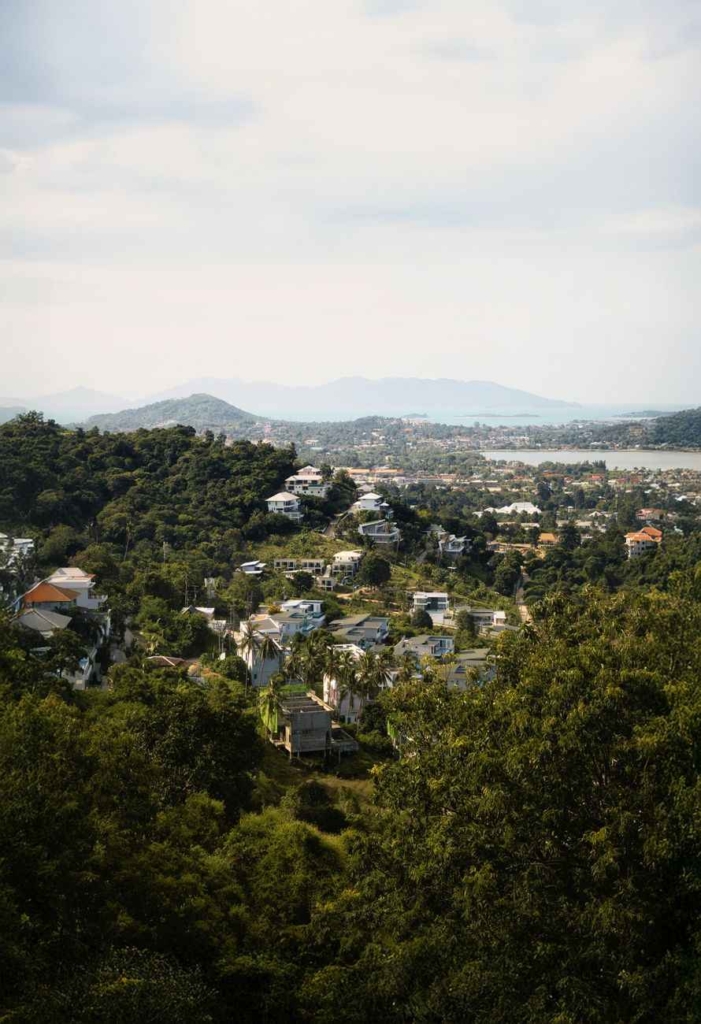
The single biggest decision you will make is which side of the island. Each area has a distinct personality, price band, and tenant mix.
Bophut and Fisherman’s Village: The Expat Default
Bophut is the most popular long-term area. The northern shore has a walkable Fisherman’s Village with international restaurants, weekend markets, supermarkets within a few minutes’ drive, and a steady expat community. Long-term villas and townhouses cluster in the hills behind Bophut. Expect ฿40,000–90,000/month for a 2-3 bedroom villa with pool, or ฿18,000–35,000/month for a 1-2 bedroom apartment. Internet is reliable, beach access is a short scooter ride, and the airport is 10 minutes away.
Maenam: Quiet Value on the North Coast
Maenam is the quiet cousin of Bophut. Long calm beach, residential streets, and noticeably lower prices. A 2-bedroom pool villa in a managed community in Maenam typically rents for ฿35,000–65,000/month. The trade-off is fewer walkable restaurants and a 15-20 minute drive to Bophut or Chaweng. Best for retirees, families with small children, and remote workers who prioritise calm over convenience.
Choeng Mon: Premium Hillside and Beach Pockets
Choeng Mon on the northeastern tip is where you find 3-5 bedroom luxury villas with sea views, gated communities, and proximity to both Bophut and Chaweng. Long-term rates start around ฿80,000/month. Best for executive relocations and families wanting resort-style living. Many Horizon Homes long-term listings sit in this corridor.
Chaweng: Central, but Choose the Right Pocket
Chaweng is the busiest, most tourist-heavy area. The central strip and southern end are not suitable for long-term living — late-night noise, traffic, and short-term rental turnover create friction. The northern and western residential pockets (Chaweng Noi, Chaweng Hills) are different stories: quiet lanes, hillside villas, and quick access to Chaweng amenities. Long-term rates ฿45,000–120,000/month.
Lamai: Mid-Tier, Family-Friendly
Lamai is the second-largest town and balances price with amenity. South Lamai in particular has good value 2-3 bedroom villas at ฿30,000–60,000/month. International schools are a 20-30 minute drive away (Bophut area). Best for families who want space for the budget, and don’t mind a 30-minute commute to school.
Bangrak: Convenience Over Charm
Bangrak sits near the airport and the main ring road, with quick access to ferry piers and shopping centres, but less charm than Bophut or Maenam. Long-term apartments dominate, typically ฿15,000–35,000/month. Best for short-term stays tied to frequent island-hopping.
Quick Area Comparison
| Area | Vibe | 2-BR Villa Range (THB/mo) | Best For | Trade-Off |
| Bophut | Expat hub, walkable | 40,000 – 90,000 | Remote workers, couples | Higher prices, busier |
| Maenam | Quiet, residential | 35,000 – 65,000 | Retirees, families | Fewer restaurants |
| Choeng Mon | Premium, hillside | 80,000 – 200,000 | Executives, luxury | Highest cost |
| Chaweng Noi/Hills | Convenient, mixed | 45,000 – 120,000 | Commuters, dual lifestyle | Traffic, noise pockets |
| Lamai | Family, mid-tier | 30,000 – 60,000 | Families, value seekers | School commute |
| Bangrak | Convenient, urban | 15,000 – 35,000 | Short stays, commuters | Less charm |
What a 2026 Long-Term Rental Actually Costs?
A realistic monthly budget for a couple renting a 2-3 bedroom pool villa in a managed estate:
- Rent: ฿40,000–80,000
- Electricity: ฿2,000–6,000
- Water: ฿500–1,500
- Internet (fibre 500/500 Mbps): ฿600–900
- Pool and garden service: Usually included
- Mobile data: ฿500–1,500
- Total realistic monthly budget: ฿45,000–95,000
Add to this the move-in costs: a 2-month security deposit plus 1 month rent in advance is the 2026 standard (3 months total at signing). Always request a receipt for every payment — this becomes critical for visa applications.
Contracts: What Every Long-Term Lease in Thailand Must Include?

A legally sound Thai rental contract contains more than a price and a date. Under the Thai Civil and Commercial Code, certain clauses must be present and certain rights cannot be waived.
Mandatory Contract Elements
- Parties and property: Full legal names, property address with land plot number (from the title deed), tenant’s passport copy attached.
- Rental term: Clear start and end date, with renewal clause if desired.
- Rent and payment schedule: Monthly amount, payment date, accepted methods. Late fees above 10% of monthly rent are unenforceable in Thai courts.
- Security deposit: Amount (typically 2 months), deduction conditions, refund timeline. The 2026 OCPB update requires landlords to return deposits within 30 days of move-out unless specific damage is documented.
- Utilities: Who pays, at what rate, and how billing is shared. Insist on actual meter readings, not flat rates.
- Maintenance responsibility: What the landlord maintains structurally versus tenant day-to-day.
- Use of property: Restrictions on subletting, commercial use, alterations. Long-term contracts should explicitly permit home-office use.
- Termination clauses: Notice period (30-60 days standard), diplomatic clause for early termination, landlord-termination conditions (non-payment, illegal activity, property sale with 60-90 days notice).
- Registration with Land Office: Required for any lease longer than 3 years. The 30-year maximum is enforceable only if registered.
- Bilingual execution: Thai and English versions, with the Thai version prevailing in case of dispute.
Clauses Most Tenants Forget to Negotiate
Three clauses professionals always push for: (1) diplomatic early-termination allowing exit after 6 months with 30-60 days notice, (2) explicit permission to operate a home office and receive mail at the property — important for visa evidence, and (3) written notice and tenant consent before any landlord visit, except in genuine emergencies.
What to Do if the Lease Exceeds 3 Years
If your contract is for more than 3 years (common for retirement visa applicants), it must be registered at the local Land Office to be fully enforceable. The landlord typically pays the registration fee. Without registration, only the first 3 years of the lease are legally binding on a new owner of the property. Always check the title deed (chanot) and confirm the landlord is the registered owner before signing.
Aligning Your Lease with Thai Visa Requirements in 2026
A 2026 reality: your rental contract is now part of your visa paperwork. The DTV, retirement (Non-Immigrant O-A), marriage, and Long-Stay Visas all have rental documentation requirements. Your lease length, declared rent amount, and landlord letterhead become immigration evidence. Cash deals and informal contracts are now actively discouraged — they will not pass the immigration counter.
DTV (Destination Thailand Visa) for Remote Workers
The DTV, launched in 2024 and extended through 2026, suits freelancers and remote workers earning at least ฿500,000 per year. It is granted for 5 years with 180-day stays renewable. For DTV evidence, immigration typically wants a 6-12 month lease with rent above ฿20,000/month and a landlord confirmation letter. Make sure the rent on the contract matches what you declare on your visa application.
Non-Immigrant O-A (Retirement Visa)
The O-A retirement visa requires applicants aged 50+ to meet financial thresholds (฿65,000/month income or ฿800,000 in a Thai bank account). Immigration asks for a 12-month lease minimum. A ฿30,000-50,000/month villa lease is the typical sweet spot for retirees.
Why a Bilingual, Dated Contract Matters for Every Visa?
The most common visa rejection cause related to housing is a mismatch between the contract terms and the visa application. Make sure dates, names, and amounts are consistent across lease, bank statements, and visa form. If your landlord uses a property management company, ask for an “immigration letter” on company letterhead confirming the tenancy.
What is the minimum rental contract length for a long-term visa in Koh Samui in 2026?
For the DTV visa, immigration typically requires a 6-month lease with monthly rent of at least ฿20,000. For retirement (O-A) and family (O) visas, a 12-month lease is the practical minimum. Anything shorter or lower is unlikely to be accepted, and any mismatch between declared income and rent is a red flag.
Common Mistakes That Cost Tenants Real Money
Experienced expats also fall into these traps in their first Koh Samui rental. Avoid them and you will save both money and stress.
Mistake 1: Paying 12-Month Prices for Short-Term Listings
Some agencies list “long-term” properties at holiday rates because the owner has not agreed to a true 6-12 month contract. Always confirm the contract length, the rent reduction from the nightly rate, and whether the price is fixed for the full term. A genuine long-term discount is 30-50% off the nightly equivalent.
Mistake 2: Skipping the Move-In Inspection
The most common deposit dispute at move-out is damage that was already there at move-in. Spend 60 minutes on move-in day walking through the villa with the agent, photographing every wall, appliance, scratch, and stained tile. Sign a move-in condition report that both parties keep. The 2026 OCPB framework makes this report legally binding, so the time spent pays back many times over.
Mistake 3: Paying the Deposit in Cash
Always pay the security deposit by bank transfer with a clear reference. Cash payments leave no paper trail, are not legally enforceable, and complicate visa applications. A bank transfer is your receipt and your proof in any future dispute.
Mistake 4: Not Checking the Title Deed and Landlord Identity
A common scam: a “landlord” rents a property they do not own, collects deposits, and disappears. Always ask to see the title deed (chanot) and the landlord’s Thai ID. The name on the deed should match the name on the contract.
Mistake 5: Ignoring Utility Meter Readings
Some private landlords add a 20-50% markup on utilities. Insist on direct meter readings and government-rate billing. Read the meters on move-in and move-out day, photograph the readings, and keep the bills.
How to Find the Right Long-Term Rental in Koh Samui?
The best 2026 long-term properties are rarely advertised on Booking.com or Airbnb — they live in agency portfolios and local expat networks.
Where to Look?
- Specialist agencies: Agencies such as Horizon Homes Real Estate and similar firms maintain dedicated long-term rental portfolios with proper contracts, English-speaking staff, and OCPB-compliant documentation. This is often the safest and most straightforward option for first-time renters.
- Facebook groups: Communities such as Koh Samui Expats, Samui Long Term Rentals, and Koh Samui Digital Nomads are active marketplaces for rental listings. While they offer a wide range of options, listing quality and landlord professionalism can vary, making due diligence essential.
- Word of mouth: Once established on the island, recommendations from the local expat and business community often become one of the most reliable ways to discover quality rental opportunities before they are publicly advertised.
Red Flags vs. Green Flags
A green-flag agent sends a bilingual contract, asks for passport and visa copies, provides a move-in inspection report, and offers a written maintenance-response commitment. A red-flag agent pushes for cash deposits, refuses to register the lease, has no physical office, or pressures you to sign before viewing. If you see the red flags, walk away.
Working with a Professional Agency vs. Private Landlord

In 2026 the choice between agency and private landlord is sharper than ever. Here’s a quick comparison.
| Option | Advantages | Potential Drawbacks | Best For |
|---|---|---|---|
| Rental Agency | Help with property selection, clearer contracts, support with negotiations, maintenance coordination and a point of contact if problems arise | Some properties may include an agency fee or slightly higher asking price | Tenants who want more support and a smoother rental process |
| Private Landlord | Direct communication, potentially more flexibility on price or lease terms, and no intermediary | Contract quality and maintenance support can vary, with fewer options if disputes arise | Experienced renters who are comfortable checking contracts and managing issues directly |
For most long-term tenants, the agency premium is worth it: a proper contract, a fixed maintenance response, and a clear dispute path.
Is Koh Samui Right for Your Long-Term Stay?
Koh Samui works for long-term living if you want a balance of island calm, modern infrastructure, and a real international community. It is not the right choice if you need urban energy, constant nightlife, or the cheapest possible cost of living. The 2026 market is mature, well-regulated, and tenant-friendly in ways it was not five years ago. With a clear understanding of areas, realistic budgeting, and a properly drafted contract, a long-term rental in Koh Samui can be one of the best lifestyle decisions you make this decade.