Koh Samui’s property market has matured into one of Thailand’s most established international investment destinations, but the useful question is no longer simply whether the island is a good place to buy. Investors need to understand which areas, property types and ownership structures fit their objectives, and whether the expected rental income justifies the purchase price.
With more than 15 years of local market experience, Horizon Homes Koh Samui has seen how different parts of the island perform across changing market conditions. This guide brings together current market data, rental indicators, area-level considerations and practical steps to help buyers assess an opportunity before committing capital.
Recent developments, including planned airport improvements and the proposed Koh Samui cruise terminal, could influence accessibility and future demand. At the same time, rising rental supply means investors need to look beyond headline yields and consider how purchase price, location, management and eventual resale all fit together.
What Does the Koh Samui Property Market Look Like in 2026?
Market Size and Investment Volume
Koh Samui’s primary residential development market comprises 2,882 units across 117 projects, with a total market value of approximately THB 30.3 billion, according to C9 Hotelworks’ 2025 market update. Condominiums account for 52% of this new supply, while landed properties make up the remainder.
The island’s rental sector is also substantial. C9 Hotelworks reported 3,055 villa rental properties in January 2025, representing a 34% year-on-year increase. Despite this growth in supply, average villa occupancy reached 71.5% in Q1 2025, up 5.7 percentage points from the previous year.
Thailand’s wider tourism figures also remain supportive. The country recorded 5,947,434 international arrivals between 1 January and 22 February 2026, according to the Thai government.
Together, these figures point to the two main ways investors typically approach Koh Samui property: rental income and longer-term capital appreciation. They can complement one another, but they do not necessarily favour the same locations or property types.
Why Koh Samui’s Market Is Different?
Koh Samui is smaller and more concentrated than Phuket, which creates both advantages and limitations.
Phuket has a larger property market, more flight connections and greater resale liquidity. Koh Samui, meanwhile, has a more limited development environment and a strong concentration of villa properties, particularly in premium coastal locations.
Another factor shaping the island is its approach to development. Building and environmental restrictions have helped Koh Samui retain a lower-rise character than destinations such as Bangkok and Pattaya. The island’s natural landscape also limits where and how property can be developed, making factors such as elevation, road access, views and proximity to established tourism areas particularly important.
This has contributed to a market where villas, hillside homes and beachfront properties remain prominent and where the characteristics of the individual property can matter as much as the wider destination.
For an investor, the comparison should therefore not be reduced to which island has the highest advertised return. Entry price, rental demand, liquidity and intended holding period can be more important than the destination’s reputation alone.
How Property Investment Returns Work in Koh Samui?
Once the structure of the market is understood, the next consideration is how an individual property could actually produce a return.
Rental Income
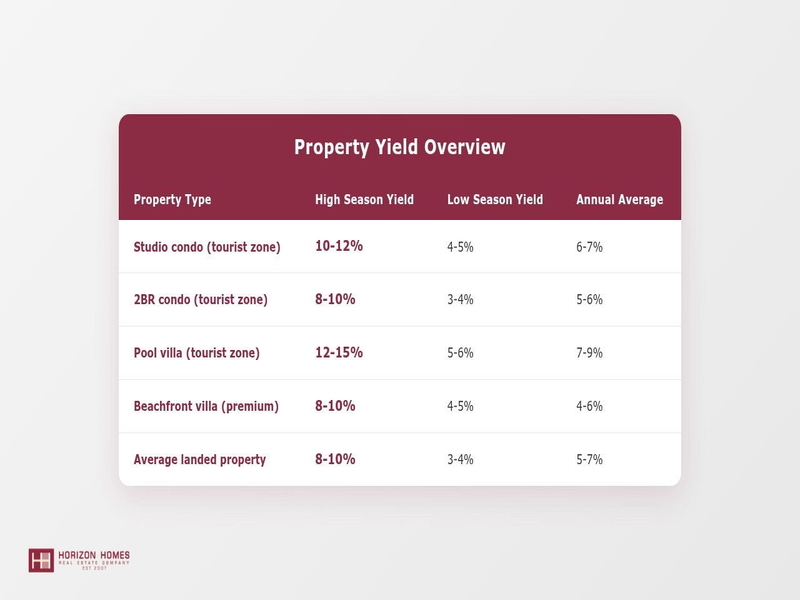
Advertised rental yields can make an investment look more attractive than it actually is. Management fees, maintenance, booking costs, insurance, utilities, taxes and periods of vacancy all reduce the amount that ultimately reaches the owner.
Current market data provides a useful benchmark. Airbtics data cited in the 2026 Samui market analysis puts median annual short-term rental income at approximately THB 1.262 million, with a 66% median occupancy rate and an average nightly rate of THB 5,188.
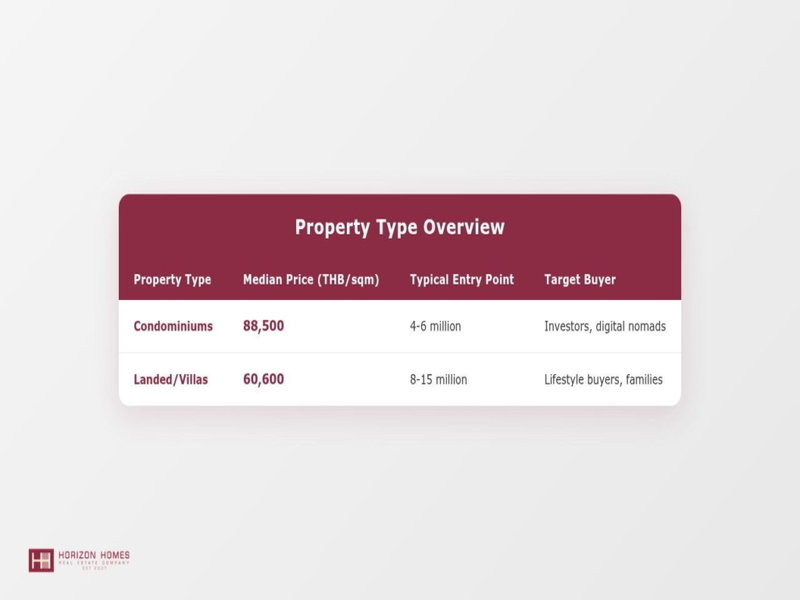
C9 Hotelworks reported a median three-bedroom villa price of approximately THB 14.9 million, while median prices were approximately THB 88,500 per square metre for condominiums and THB 60,600 per square metre for villas and landed properties.
These figures should be treated as market benchmarks rather than guaranteed returns. Location, design, management, purchase price and the amount of personal use can all change the outcome considerably.
Typical operating costs can include:
- Property management
- Maintenance and repairs
- Utilities
- Insurance
- Booking and marketing fees
- Common-area fees for condominiums
- Taxes
- Owner-use periods that remove potential rental nights
A realistic investment assessment therefore starts with expected net income rather than an advertised gross yield.
Capital Appreciation
Capital appreciation is the other potential part of the return, but land and property values do not rise at a fixed rate.
Market reports and local industry estimates have pointed to continued price growth in prime Samui submarkets, supported by limited land availability, tourism demand and infrastructure investment. Rather than assuming a particular annual appreciation rate, buyers should consider whether a property would still make sense if prices remained relatively flat for several years.
Infrastructure is one potential medium-term catalyst. Samui Airport improvements are intended to increase future capacity, while a proposed cruise terminal at Laem Hin Khom in Taling Ngam has an estimated investment value of THB 12.172 billion.
The cruise-terminal project remains subject to the relevant development and approval process. It should therefore be treated as a potential influence on future demand rather than as guaranteed appreciation.
That distinction matters when deciding how much to pay for a property today based on what might happen several years from now.
How Much Does Property Cost in Koh Samui in 2026?
Koh Samui covers a broad price range, meaning the available budget can significantly change the type of property and investment strategy open to a buyer.
Current market data places the median condominium price at approximately THB 88,500 per square metre, compared with THB 60,600 per square metre for villas and landed properties. The median price for a three-bedroom villa is approximately THB 14.9 million.
A useful way to view the broader market is:
| Property type | Indicative price range | Typical investment profile |
|---|---|---|
| Entry villa, garden view | THB 5M–12M | Lower entry point, often leasehold |
| Mid-range villa, sea view | THB 12M–25M | Strong rental and lifestyle potential |
| Luxury hillside villa | THB 25M–70M | Premium holiday market |
| Beachfront estate | THB 70M+ | Limited supply, high-value asset |
| Entry-level condo | THB 2.5M–5M | Potential freehold, quota-dependent |
| Mid-range condo | THB 5M–10M | Practical freehold option for foreigners |
| Luxury condo | THB 10M–15M+ | Limited stock, premium positioning |
These are broad market bands rather than valuations for individual properties. The same budget can produce very different outcomes depending on road access, views, land size, construction quality and proximity to established tourism areas.
Property Types in Koh Samui
Price is only one part of the decision. Koh Samui also has a distinctive mix of property types, each suited to different combinations of investment, lifestyle use and ownership priorities.
Villas and Hillside Homes
Private villas are one of the island’s most characteristic property types. They frequently include private pools, outdoor living areas and multiple bedrooms, making them suitable for both personal use and the holiday rental market.
Koh Samui’s terrain has also created a substantial market for hillside and sea-view villas. Elevated locations can provide privacy and panoramic views, although road access, gradient, drainage and construction quality become especially important.
Beachfront Property
Genuine beachfront property occupies a more limited part of the market because direct-beach locations are naturally constrained.
These properties can command premium prices and appeal to high-end buyers and holiday renters, but investors should still assess the individual property rather than assuming beachfront positioning automatically produces a stronger return.
Condominiums
Condominiums represent a smaller but important part of the market. They generally require less day-to-day maintenance than standalone villas and can provide the most straightforward route to foreign freehold ownership when foreign quota is available within the development.
Commercial Property
Koh Samui’s tourism economy also supports resorts, restaurants, boutique hotels and other commercial property.
These should be viewed differently from residential investments because performance depends on the underlying business, operating costs and commercial demand as well as the property itself.
For most residential investors, however, the central decision remains whether a villa or condominium better fits their objectives.
Is a Villa or Condominium Better for Investment?
Approximately 89% of Koh Samui property listings are reported to be villas, reflecting the island’s strong preference for standalone tropical accommodation.
Villas can be particularly attractive to lifestyle investors who want to use the property themselves for part of the year while renting it to holiday guests during other periods. Private pools, sea views, outdoor space and multiple bedrooms can help differentiate a property in the short-term rental market.
Condominiums offer a different proposition. They generally involve less day-to-day maintenance and can provide the clearest route to foreign freehold ownership, provided the development has available foreign quota.
For buyers focused on rental income combined with lifestyle use, a well-positioned villa can make sense. Someone prioritising simpler ownership and lower maintenance may find a qualifying freehold condominium more appropriate.
The right choice therefore depends on how the property will actually be used, rather than simply which category has the highest advertised yield.
Where Are the Best Areas to Invest in Koh Samui?
Once the preferred property type is clear, location becomes the next major decision. Different parts of Koh Samui attract different tenant and buyer profiles, so there is no single best area for every investment strategy.
Chaweng: Established Tourism Demand
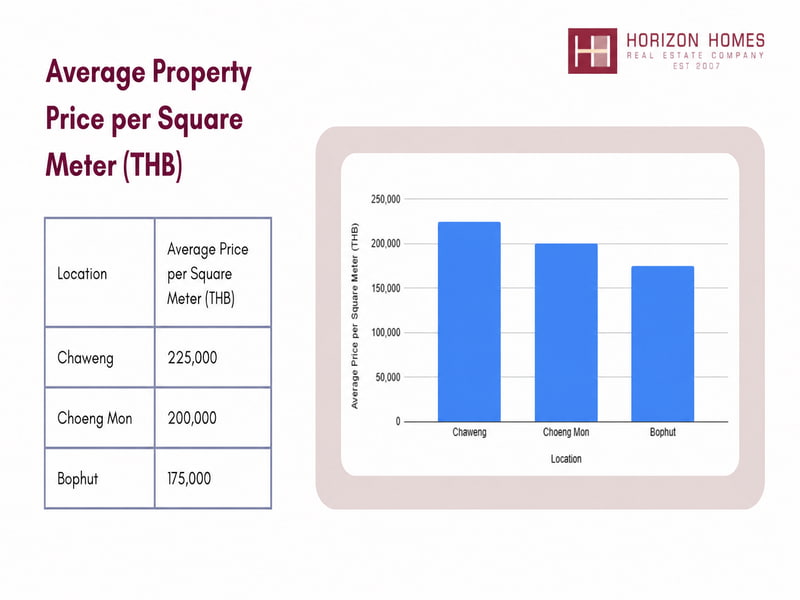
Chaweng remains the island’s main commercial and tourism centre, with restaurants, nightlife, hotels and beach activity supporting visitor demand.
The area can suit investors prioritising short-term rentals and liquidity, but competition is also significant. Properties need a clear advantage, whether that comes from location, views, facilities, design or professional management.
Chaweng Noi: Premium Sea-View Market
Chaweng Noi is a hillside luxury area with strong demand for high-quality sea-view villas.
It can suit buyers with larger budgets who want exposure to the premium holiday rental market. The higher acquisition cost means purchase price and expected occupancy need to be assessed carefully rather than assuming a premium location automatically produces a better return.
Bophut: Rental Demand and Lifestyle Appeal
Bophut and Fisherman’s Village combine restaurants, shops, beach access and established tourism infrastructure.
The area can work well for buyers seeking both personal-use potential and rental income. Longer-stay visitors can also broaden the potential tenant base beyond short holiday bookings.
Choeng Mon: Family-Oriented Demand
Choeng Mon offers a quieter environment while remaining close to the airport and northern tourist areas.
Its sheltered beach and growing selection of quality developments make it worth considering for investors targeting families, couples and longer-stay visitors.
Lamai: A Different Entry Point
Lamai is another established tourism centre and generally offers a different price point from some of the island’s most expensive northeastern areas.
It can suit buyers looking for a balance between rental demand, lifestyle use and acquisition cost. Investors should nevertheless compare projected income with the purchase price and operating expenses rather than relying on a lower entry price alone.
Maenam, Bang Por and Lipa Noi: Lower-Density Alternatives
Maenam and Bang Por have a quieter, more residential character and can appeal to long-term tenants and visitors seeking privacy.
Lipa Noi, on the west coast, has a lower-density environment and a concentration of higher-value villas. Its position near the proposed Taling Ngam cruise-terminal area has also attracted attention from buyers considering longer-term infrastructure growth.
Across these quieter areas, rental performance can depend more heavily on the characteristics of the individual property. Access, views, facilities and management therefore become especially important.
Is Koh Samui Better Than Phuket for Property Investment?
Location within the island matters, but international investors may also be deciding whether Koh Samui is the right island at all.
Phuket offers greater market scale and liquidity, with more flight connections, a larger selection of comparable properties and a broader resale market.
Koh Samui offers a more concentrated market, with strong villa demand and a smaller development environment in many premium locations. This can appeal to buyers who are comfortable with a longer holding period and want exposure to a lifestyle-led rental market.
For someone who may need to sell quickly, Phuket’s larger market can be an advantage. For a buyer planning to hold for five to ten years and prioritising a villa or lifestyle property, Koh Samui may deserve closer consideration.
The better destination is therefore determined by budget, property type, rental strategy and investment horizon, rather than by a blanket ranking.
Renting Before Buying: When It Makes Sense?

Not every prospective buyer needs to move directly from research to ownership.
Buying may make sense for someone who expects to use Koh Samui regularly, wants longer-term exposure to the property market or intends to generate rental income when the property is not being used personally.
Ownership also provides greater control over the property and the ability to position it for a particular market. However, the buyer needs to account for transaction expenses, maintenance, management and the appropriate legal structure.
Renting offers a different advantage: flexibility.
For someone unfamiliar with Koh Samui, renting before buying can provide first-hand experience of different parts of the island. Spending time in areas such as Bophut, Chaweng, Choeng Mon, Lamai or Maenam can reveal practical differences in traffic, road access, amenities and atmosphere that may be difficult to judge remotely.
It also allows a prospective buyer to refine what they actually want from a property before making a long-term commitment.
Once a buyer is confident about both the island and the preferred investment strategy, the focus can shift from market research to evaluating an individual purchase.
What Should a Practical Koh Samui Property Investment Roadmap Look Like?

At this point, the question changes from whether Koh Samui fits the investor’s objectives to whether a particular property does.
Step 1: Establish the Legal Structure
Before making an offer, engage an independent Thai property lawyer who regularly handles foreign purchases.
For most international buyers, the main structures to understand are:
- Freehold condominium: The clearest ownership route for foreigners, subject to the 49% foreign quota.
- Leasehold: Common for villas and land, normally involving a registered lease with a defined term.
- Thai company structure: Requires genuine commercial and ownership arrangements and should never rely on nominee shareholders.
The structure should be decided before signing a purchase agreement, not afterwards.
Step 2: Compare Locations in Person
If possible, visit the island before committing capital. Compare road access, surrounding development, beach access, views, construction quality and the atmosphere at different times of day.
For overseas buyers, video viewings, neighbourhood comparisons and detailed property inspections can help, but they do not completely replace an in-person assessment.
Step 3: Build the Financial Model
Start with the actual purchase price rather than an advertised yield.
Model:
- Expected occupancy
- Realistic nightly or monthly rates
- Management fees
- Maintenance
- Insurance
- Utilities
- Taxes and transaction costs
- Owner-use periods
- Financing costs, if applicable
- A reserve for unexpected repairs
For foreign buyers considering financing, UOB Thailand has a structured mortgage programme for qualifying freehold condominium purchases, while developer instalment plans can be available for some off-plan projects. Terms and eligibility should be confirmed directly with the relevant lender or developer before relying on them.
Step 4: Complete Due Diligence
Before exchanging contracts, verify:
- Title deed and registered encumbrances
- Foreign ownership quota for condominiums
- Lease terms where applicable
- Zoning and permitted land use
- Building permits and relevant approvals
- Property boundaries and access
- Utility connections
- Management agreements
- Common fees and sinking funds for condominiums
- Historical rental performance where available
An independent legal review is particularly important when buying land, a villa or a property involving a company structure.
Step 5: Plan the Exit Before Completing the Purchase
A property is not only an income-producing asset. It is also something that may need to be sold later.
Ask who the likely buyer will be in five or ten years. A property aimed at a very narrow luxury segment may take longer to sell than a well-priced villa in an established rental area.
This is where location, ownership structure and purchase price come together. A strong investment case should make sense when buying, while holding and when eventually selling.
What Could a 5–10 Year Koh Samui Property Investment Look Like?
A long holding period can smooth out short-term market movements, but different properties can still produce very different outcomes. Scenario modelling is therefore more useful than promising a single return.
Conservative Scenario: Secondary Location, Average Property
- Years 1–3: Rental income covers a significant portion of operating costs while appreciation remains modest.
- Years 4–5: Net cash flow may improve as the property establishes a rental history.
- Years 5–7: The investment reaches a stronger cumulative return position.
- Year 10: Overall performance depends heavily on occupancy, maintenance and resale value.
Moderate Scenario: Prime Location, Quality Property
- Years 1–2: Stronger rental demand supports operating income.
- Years 3–4: Rental income and appreciation begin contributing more substantially to the overall return.
- Year 5: The property has a more established operating history.
- Year 10: Long-term performance depends on both rental income and the eventual sale price.
Optimistic Scenario: Premium Villa Benefiting from Strong Demand
- Year 1: Strong rental demand can support income from the beginning.
- Years 2–3: High occupancy and premium rates may improve overall performance.
- Years 4–5: Continued tourism and infrastructure development could support appreciation.
- Year 10: The result could be significantly stronger, but it remains dependent on market conditions.
These scenarios are easier to interpret when viewed in the context of real estate market cycles and investment strategy, particularly for buyers considering how market conditions may change during a five-to-ten-year holding period.
They should still be treated as planning frameworks rather than forecasts. No property should be purchased on the assumption that its value will double or that a particular annual return is guaranteed.
What Risks Should You Stress-Test Before Buying Property in Koh Samui?
Potential returns are only useful when considered alongside the risks required to achieve them.
Koh Samui has attractive fundamentals, but its tourism-led market also creates specific considerations:
- Seasonality: Occupancy and nightly rates can change substantially during the year.
- Rental supply: More villas entering the market can put pressure on rates.
- Liquidity: A highly specialised luxury property may take longer to sell.
- Currency movements: Exchange rates can materially affect returns for overseas buyers.
- Management quality: Poor maintenance or guest management can reduce income.
- Legal structure: Incorrect ownership arrangements can create serious problems.
- Infrastructure uncertainty: Proposed projects may be delayed, changed or cancelled.
- Purchase price: Paying too much at entry can undermine an otherwise attractive asset.
The most useful approach is to stress-test the investment using lower occupancy, higher expenses and slower appreciation to see whether the numbers still work under less favourable conditions.
Our guide to real estate investment risk management looks more closely at market, liquidity, operational and legal risks for property investors.
What Should You Check Before Buying Property in Koh Samui?
After identifying a suitable property and testing the financial assumptions, the final stage is verification.
Before committing to a purchase, an international buyer should check:
- Title and ownership: Check the title deed and registered encumbrances.
- Foreign ownership eligibility: Confirm condominium quota before signing where applicable.
- Lease terms: Review registration, duration and renewal provisions independently.
- Building compliance: Check permits and relevant approvals.
- Property condition: Inspect drainage, waterproofing, electrical systems and major equipment.
- Rental performance: Request historical income and occupancy data where available.
- Operating costs: Include management, maintenance, insurance, utilities and common fees.
- Location: Check road access, utilities, flood exposure and surrounding development.
- Exit strategy: Consider the likely buyer pool in five or ten years.
- Legal structure: Obtain independent Thai legal advice before committing to a complex arrangement.
Buyers who want to go deeper into ownership considerations, property selection and the purchasing process can use our Koh Samui buyers guide alongside their independent legal due diligence.
Conclusion
At Horizon Homes Koh Samui, we believe the strongest property decisions start with understanding how the different parts of an investment fit together. The Koh Samui real estate market offers opportunities across villas, condominiums and premium coastal property, but the right choice depends on purchase price, location, ownership structure, realistic rental performance and the intended holding period. Our experience on the island helps buyers assess those factors together rather than relying on headline yields or assumptions about future growth.
Frequently Asked Questions
Is Koh Samui a good place to invest in 2026?
Koh Samui can be attractive for investors seeking rental income, lifestyle use and longer-term property exposure. The island has established tourism demand and a substantial villa rental sector, but results vary significantly by location, property type, purchase price and management quality.
How much does property cost in Koh Samui?
C9 Hotelworks reports median prices of approximately THB 88,500 per square metre for condominiums and THB 60,600 per square metre for villas and landed properties. The median price for a three-bedroom villa is approximately THB 14.9 million.
Can foreigners buy property in Koh Samui?
Foreigners can own qualifying condominium units on a freehold basis within the applicable foreign ownership quota. Land ownership is more restricted, meaning villa and land purchases require careful consideration of the legal structure. Independent Thai legal advice should be obtained before signing.
Does buying a villa guarantee a good rental return?
No. Rental performance depends on the purchase price, location, property quality, management, occupancy, nightly rates and operating costs. Market averages can provide a benchmark but should not be treated as a guarantee for an individual property.
How long should an investor plan to hold Koh Samui property?
There is no universal holding period, but buyers should consider their exit strategy before purchasing. A five-to-ten-year horizon may give an investment more time to establish rental performance and move through different market conditions, although future appreciation is never guaranteed.
What infrastructure projects could affect Koh Samui property values?
Airport improvements and the proposed THB 12.172 billion cruise terminal at Laem Hin Khom in Taling Ngam are among the infrastructure developments being watched by the market. They could support accessibility and tourism over the longer term, but investors should not assume that either project will automatically produce property-price appreciation.